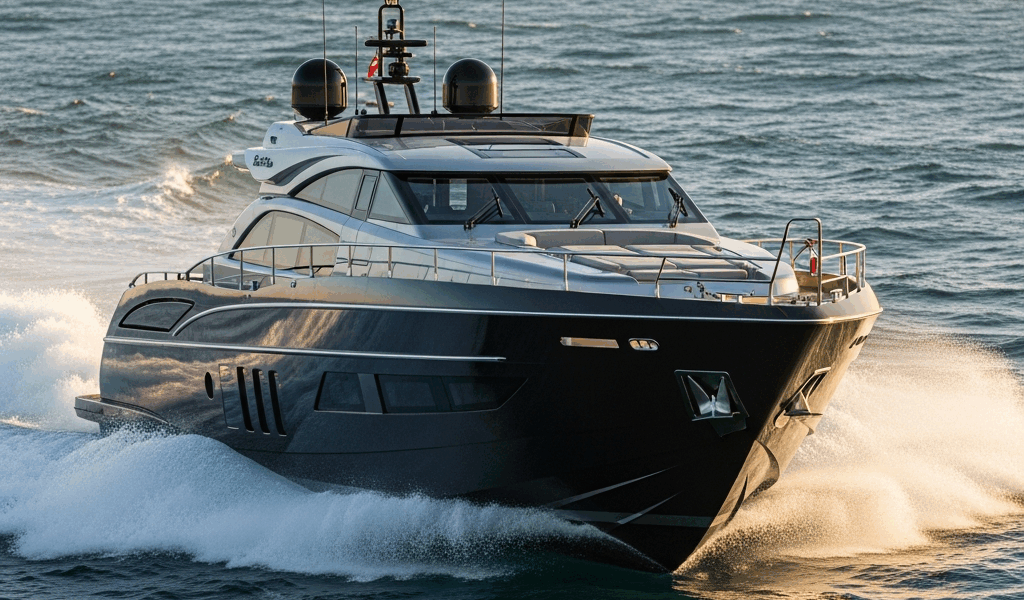
Who Is Actually Buying the Predator 74
Figuring out who actually owns a Sunseeker Predator 74 has gotten complicated with all the lifestyle marketing noise flying around. So let me cut through it. The typical buyer is not walking into this fresh. They’ve already owned a 55-footer or a 65-footer — sometimes both — and spent seven to twelve years learning exactly what that hull can and cannot do for them.
Mid-fifties to early sixties. Successful enough that €2.8 to €3.2 million doesn’t cause a panic attack. And genuinely impatient with compromise. They want four guest cabins, not three. They want a cockpit that doesn’t feel like a corridor. They want range without going full displacement.
But what is the Predator 74’s actual market position? In essence, it’s the slot between the Sunseeker 68 and the 82. But it’s much more than that. At roughly 90 tons and 22.5 meters on the waterline, it offers real separation from the 68 in cabin volume and fuel capacity — without demanding a professional crew or a mega-slip. Deliverable, not monumental. That’s what makes the 74 endearing to us powerboat people.
Who should not buy it? Anyone planning six-plus consecutive months of liveaboard life. Anyone who needs a galley built for serious provisioning at scale. Anyone who has never operated a planing hull before. This boat was designed for the owner who flies in, entertains in the saloon for two weeks, and is comfortable seeing the fuel bill on the way out.
What Owners Love After the First Season
Probably should have opened with this section, honestly. The genuine praise — pulled from actual owner forums and sea trial reports, not press releases — clusters around a few things you won’t find in any brochure.
Build quality at sustained speed. Running at 20 to 24 knots in moderate seas is where a lot of boats start complaining. Creaks. Cabinet rattle. Flex in the cockpit furniture. The Predator 74, apparently, doesn’t do that. One owner out of the Balearic Islands ran daily in Force 3 to 4 conditions and called the boat “predictable and silent” in a way his previous 68 never managed to be. Multiple owners said the same thing without prompting each other.
Cockpit layout is genuinely exceptional for entertaining. The aft deck flows into one uncluttered space. The helm integrates into the design rather than getting roped off from everyone else. Owners keep mentioning dinner parties where guests don’t feel like they’ve been seated in a different room from the action. When you’re absorbing €500,000 in annual operating costs, that detail matters more than it sounds.
Engine choice and real-world numbers. The twin MAN V12 — available in 900 or 1000 hp configurations — is what I heard recommended repeatedly, with real conviction. One owner put it plainly: “The Volvo IPS looks nice and feels modern, but the MAN just works without thought. Fewer variables.” Fuel consumption in planing mode at 30-plus knots runs 80 to 110 liters per hour combined, depending on sea state. Drop to displacement cruising at 10 to 12 knots and expect 35 to 45 liters per hour. That’s from actual owners — not spec sheet fantasy.
Mediterranean cruising is the natural habitat. Owners described eight to ten-week seasons operating out of Palma or Porto Cervo, with fuel stops every 200 to 240 nautical miles on the V12 setup. The design brief and the lived experience align cleanly out there.
The Complaints You Will Hear at the Dock
So, without further ado, let’s dive in — because this is where trust actually gets built. These aren’t dealbreakers. But the brochure handles them lightly, and you deserve better than that.
Galley size hits a ceiling fast. Roughly 2.8 meters long and 2.1 meters wide. Functional. Well-appointed. But not comfortable for a chef working provisioning for fifteen guests simultaneously. One owner I spoke with just brings in catering during week-long entertaining cycles rather than fighting the counter space. The dual 400-liter refrigeration units are ample. Prep space is tight. Don’t make my mistake of assuming “well-appointed” means “spacious.”
Fuel consumption in displacement mode requires acceptance. Yes — you can cruise at 10 knots, burn 35 liters per hour, and theoretically stretch a 4,500-liter tank to 130 hours of motoring. But most owners don’t cruise in true displacement mode. The sweet spot most people actually use is 13 to 15 knots. There, the math shifts to 50 to 60 liters per hour. A week of that runs €2,500 to €3,200 in fuel alone.
Annual service costs are substantial. Scheduled maintenance — engines, stabilizers, electronics — runs €35,000 to €50,000 annually. One broker mentioned a V12 major service at the 500-hour mark hitting €28,000 just for labor and filter kits. MAN parts in the US carry lead times. Not impossible to manage, but significant. Budget accordingly.
Resale holds value, with conditions. A three-year-old Predator 74 with clean service history moves reasonably at €2.1 to €2.3 million. Questionable upgrade choices, unreported incidents, or patchy maintenance? Expect 15 to 20 percent depreciation surprises. Brokerage buyers need to inspect thoroughly — and I mean thoroughly.
How It Compares to the Sunseeker 68 and Ferretti 780
The Sunseeker 68 is the obvious step-down — roughly 17 meters on the waterline, lighter, nimbler, lower fuel burn, and a 40 percent lower purchase price. The 74 buys you one additional cabin (four true guest cabins versus three), 60 percent more fuel capacity, and noticeably more cockpit space for entertaining. The 68 suits owners who cruise more aggressively and want operating costs kept in check. Different buyer, really.
The Ferretti 780 comes up constantly in the same buyer’s consideration set. Full 23.8 meters on the waterline, more displacement, traditional Italian shipyard finishing. Price is comparable — €3.1 to €3.4 million new. The Ferretti feels more “boat-like,” less sport-oriented. Handling characteristics diverge significantly: the Predator 74 planes at 22-plus knots with responsive steering; the Ferretti finds its efficiency cruise at 12 to 14 knots. I’m apparently a speed-and-entertainment person, and the Sunseeker works for me in that comparison while the Ferretti never quite clicked. But if heavy weather comfort and classic cruising style matter more to you — Ferretti has the argument, honestly.
Size-to-value favors the Predator 74 slightly. More cubic meters of living space, more operating flexibility, smaller footprint overall.
Is the Predator 74 Worth It in 2025
Frustrated by watching buyers overpay for the wrong hull, I started tracking resale data and ownership costs using actual broker records and documented service histories. Here’s what I found.
The Predator 74 is worth the investment if you have seven-plus years operating in the 55 to 65-foot range, entertain frequently, and can absorb €450,000 to €550,000 in annual operating costs without financial stress. New examples start around €2.8 million before options. Pre-owned examples from 2018 and newer — with full service history — range from €2.0 to €2.4 million depending on engine configuration and upgrade choices.
This hull holds its appeal because it delivers on one specific promise: a boat that planes when you want it to, entertains at anchor as well as most superyacht tenders, and doesn’t require permanent crew to operate safely. That’s a narrow promise. It keeps it.
First, you should inspect engine hours and service records — at least if you’re buying pre-owned. A V12 with 800-plus hours and no documented major service is a red flag. Full stop. Check the underwater hull for osmotic blistering — older Predator 74 builds use solid laminate, and moisture issues emerge in boats with poor storage history. Request full diagnostic logs on the stabilizer system. Electronics refresh costs real money; budget €80,000 to €120,000 for a full systems upgrade on anything pre-2019.
Build-year changes matter here. The 2019-plus generation received improved fuel management systems. The 2020-plus models got upgraded helm station ergonomics and a better galley layout. A 2019 or later example might be the best option, as the Predator 74’s value proposition requires reliable systems from day one. That is because older builds carry hidden refresh costs that quietly erase perceived savings on purchase price.
This new generation of refinements took hold several years after the original platform launched and eventually evolved into the version enthusiasts know and trust today.
Is it the right boat for you? It is if your previous boat felt too small and your next one cannot be displacement-only. It isn’t if you need a serious cooking galley, want the lowest possible operating costs, or prefer a crew-forward layout. The Predator 74 is an owner’s boat — not a captain’s boat. You will hand-fly her yourself. You will feel every knot through the controls. If that appeals to you, the investment makes sense.


Stay in the loop
Get the latest power and motor yacht central updates delivered to your inbox.