The Core Question Buyers Actually Ask
The Sunseeker Manhattan 68 vs 74 debate has gotten complicated with all the spec-sheet noise flying around.
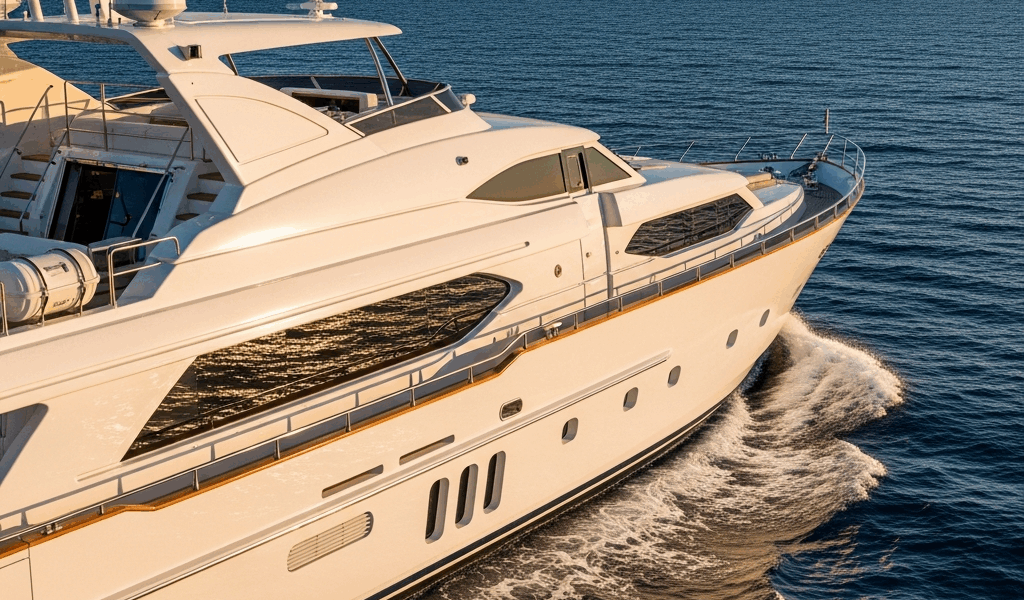
Quick orientation first. The Manhattan 68 runs approximately 20.9 meters LOA with a 5.45-meter beam — new pricing typically lands in the £2.1M–£2.4M range depending on specification. The Manhattan 74 stretches to 22.6 meters with a 5.56-meter beam, and you’re looking at roughly £2.9M–£3.3M new. Six feet of extra boat. Often a £700,000 swing before you’ve touched a single option. That gap matters enormously, and we’ll come back to it.
But what is this decision, really? In essence, it’s a use-case question disguised as a size question. But it’s much more than that. Three variables actually drive the choice: whether your primary use is coastal day-charter entertaining or extended passage-making, what slip length your home port can realistically accommodate, and whether you’re owner-operated or running with crew. Everything else — interior finishes, helm layout, the optional deck shower — is secondary noise. The buyers who got it wrong weren’t confused about the specs. They were confused about themselves.
So, without further ado, let’s dive in.
Layout and Livability Below Decks
Probably should have opened with this section, honestly.
The 68’s standard layout is a three-cabin arrangement — master amidships, two guest cabins forward — with the galley positioned aft on the main deck. It works well. For a couple who takes the boat out forty weekends a year and brings two other couples twice a summer, the flow makes sense. The saloon feels genuinely connected to the cockpit. The galley isn’t buried below. Master cabin headroom runs around 1.95 meters, which doesn’t punish taller owners the way some 20-meter hulls do.
The 74 changes the calculus significantly. Its optional four-cabin, four-head configuration adds something most buyers undervalue until they actually need it — a dedicated crew berth. That fourth cabin isn’t a luxury. It’s a functional necessity if you’re running with a paid captain who needs their own space rather than doubling up with guests. The galley moves below decks in the full-crew layout, which improves main deck entertaining space considerably. The trade-off: it creates a disconnected cooking experience that frustrates owner-operators who want to be part of the social flow while preparing food. That’s what makes the 68’s galley-up layout endearing to us owner-operators — you’re never exiled from your own party.
For a family of four using the boat primarily as a summer home — week-long Adriatic itineraries, kids who need their own space, gear storage that doesn’t involve Tetris every departure — the 74 layout wins. It isn’t close. For a couple who entertains seasonally and wants simplicity the rest of the time, the 68 is simply more livable daily. Most buyers anchor on cabin count without ever thinking through how galley placement changes the actual experience. Don’t make my mistake.
Running Costs and Marina Reality
Here’s where comparison articles usually get vague. Not here.
Both models run twin Volvo IPS or MAN diesel configurations. While you won’t need to obsess over every RPM curve, you will need a handful of real numbers to make this decision honestly. The 68 in standard twin MAN V8-900 configuration burns approximately 180–210 liters per hour at cruise — around 24–26 knots. The 74 in comparable MAN V12-1400 twin setup is burning closer to 260–290 liters per hour at similar cruise speeds. Across a two-week Mediterranean itinerary covering 600 nautical miles, that’s a fuel delta of roughly €4,000–€6,000 depending on local diesel prices. Every trip. That’s not a footnote. That’s a real operational cost compounding annually.
Annual maintenance on the 68 runs approximately £35,000–£55,000 depending on age, scope of work, and whether you’re doing winter lay-up in a yard or keeping her in the water year-round. The 74 reliably runs £50,000–£75,000 in the same scenario. The spread on haul-out costs alone — hull treatment, antifouling, running gear — reflects the additional wetted surface and heavier prop shafts. Real money, every cycle.
Marina fees are where the 74 creates a genuine operational constraint that buyers routinely underestimate. In Ibiza, Porto Cervo, Antibes, and across the Balearics, berth pricing typically brackets at 20 meters and again at 24 meters. The 74 at 22.6 meters LOA sits in the upper bracket at most Mediterranean marinas — expect to pay 30–45% more per night than the 68 at the same port. In peak July–August weeks in Sardinia, that differential can run to €800–€1,200 per night. I’m apparently obsessive about marina receipts and tracking the numbers works for me while handwaving the annual costs never does. On the US East Coast, the same dynamic applies at busy Florida ICW marinas where 20-meter slips are abundant and anything above 22 meters requires advance booking and premium pricing. Certain smaller Croatian and Montenegrin ports require advance berth coordination for the 74 — not optional. A real planning burden for owners who prefer spontaneous cruising.
Performance on the Water
First, you should understand that these two boats have genuinely different personalities — at least if you’ve spent meaningful time behind the helm of each.
I was surprised by the 68’s responsiveness the first time I pushed one through a moderate Mistral chop north of Menorca. That was 2021. The shorter waterline and lighter displacement make it genuinely agile at speed — top end around 34–35 knots, comfortable cruise in the 26–28 knot range, and the hull recovers from beam chop without the labored pitching you sometimes get in this LOA category. It’s a lively boat. Not sporty the way a Fairline Squadron 65 is sporty, but confident and fast-reacting on the helm.
The 74 is a different character entirely. Top speed sits around 33 knots, but that’s not why you buy it. At 22 knots on a passage day — Dubrovnik to Hvar, say, or running offshore from Miami to the Bahamas — the 74 is noticeably more settled. The extra length absorbs sea state. Passengers who get uncomfortable on the 68 in a two-meter swell are typically fine on the 74. For passages over four hours, that matters enormously for the non-driving guests.
The 74 might be the best option for bluewater passages, as extended cruising requires genuine seakeeping ability. That is because the longer hull distributes wave energy across a greater waterplane — physics the 68 simply can’t replicate. One honest note, though: Manhattan 74 builds from 2018–2021 have a documented tendency toward exhaust drone in the 1,800–2,100 RPM range that some owners find intrusive at extended cruise speeds. Sunseeker addressed this partially in post-2022 builds with revised exhaust routing. If you’re looking at brokerage examples in that build window, test at cruise RPM before committing. The 68 doesn’t carry the same complaint pattern — its exhaust note is cleaner across the cruise range.
Who Should Buy Which One
Stop waiting for the diplomatic non-answer. Here it is straight.
Buy the Manhattan 68 if you’re doing frequent coastal runs — weekends out of a busy marina with a 20-meter slip, Mediterranean summers where spontaneous port stops matter, entertaining that’s social rather than charter-scaled. Owner-operated pairs especially benefit from the 68’s more manageable systems load and the galley-up layout that keeps the skipper connected to the group. You will not miss the fourth cabin. You will appreciate the lower marina bills every single time you check in.
Buy the Manhattan 74 if you’re planning two-week-plus itineraries, need the crew cabin for a professional captain, or have genuine charter revenue aspirations requiring four guest cabins and the amenity level to justify day rates above €5,000. The longer hull earns its cost on passages. Accept the berth planning overhead. Budget the fuel and slip premium honestly — the boat delivers on comfort and space when used for what it was actually designed for.
Resale behavior: the 68 is moving faster in the current brokerage market. Inventory is tighter, the buyer pool is broader, and marina-fee reality is pushing buyers toward sub-21-meter hulls. Well-specified 68s from 2020–2022 are holding 72–78% of original purchase value at three years old. The 74 depreciates slightly harder — typically 65–70% at the same age — partly because the pool of qualified buyers at that price and operating cost point is simply smaller. That was true in 2022 and it’s more pronounced now. If capital preservation matters to your ownership math, the 68 is the more defensible position. That’s what makes the 68 endearing to us pragmatic buyers — it gives you most of the experience with considerably less of the exposure.


Stay in the loop
Get the latest power and motor yacht central updates delivered to your inbox.