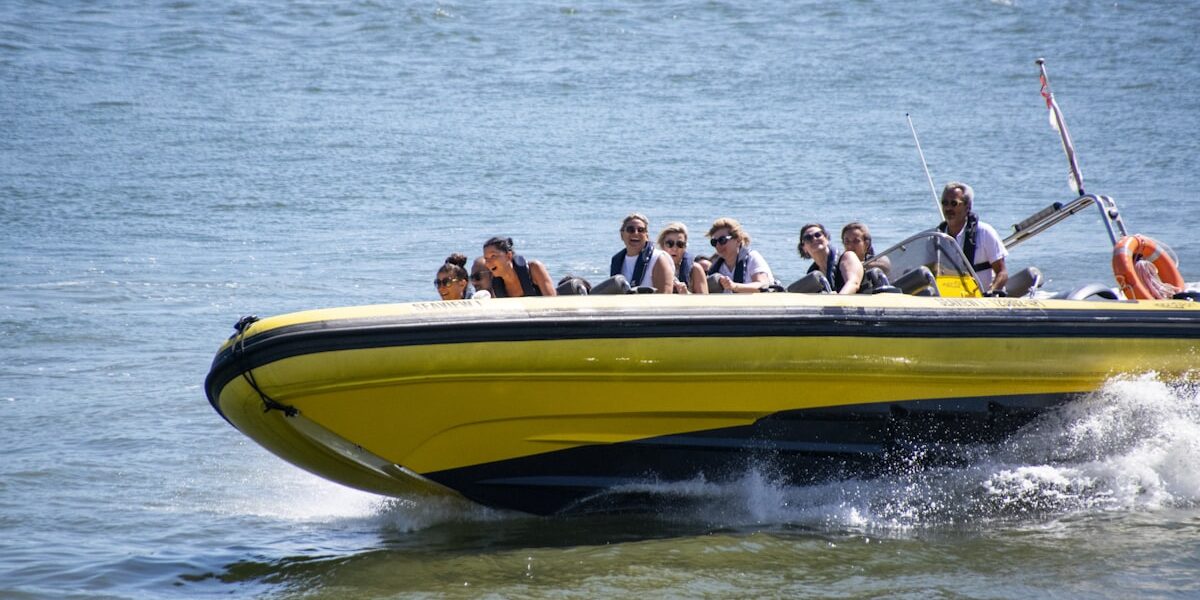
No propeller, no cavitation, no damage from running aground—jet drives have earned a devoted following among boaters who work in shallow water. Whether navigating skinny flats, approaching beaches, or operating around swimmers, jet propulsion offers capabilities that conventional propeller-driven boats simply can’t match.
How Jet Drives Work
Jet drives draw water in through an intake grate, accelerate it through an impeller, and expel it through a nozzle at the stern. The reaction force from this expelled water pushes the boat forward—exactly like a jet engine works with air.
Steering works by redirecting the water jet. Buckets or directional nozzles deflect the flow left, right, or even backward for reverse thrust. There’s no rudder to turn, no transmission to shift—just redirected thrust.
The absence of external propulsion components below the hull enables remarkable shallow-water capability. Many jet boats operate in 12-18 inches of water without risk of damage.
Shallow Water Mastery
The primary reason boaters choose jet drives is access to water that would destroy conventional propellers. Flats fishing, duck hunting, beachfront recreation, and river running all benefit from the ability to operate in minimal depth.
Even in deeper water, the absence of propellers below the hull provides peace of mind. Floating debris, submerged logs, and unmarked hazards that would shear props merely cause jet boats to bump and continue.
Running aground is less catastrophic. Where a propeller-driven boat might strand or suffer damage, a jet boat often powers through or backs off without consequence.
Swimmer Safety
No propeller means dramatically reduced risk to swimmers in the water. Jet boats are standard equipment at wakeboard and waterski schools where boats operate in close proximity to people in the water.
This safety advantage extends to any situation where boats operate near swimmers—pulling tubes, picking up divers, or navigating crowded swimming areas.
Performance Characteristics
Jet drives accelerate quickly and respond instantly to throttle input—there’s no delay while a propeller catches water. This responsiveness makes jet boats feel lively and maneuverable.
Top speeds compare favorably with conventional propulsion, though efficiency at cruise speeds typically favors propellers. Jets work best in applications that value shallow draft and maneuverability over long-range cruising efficiency.
Stopping power is impressive. Directing the jet stream forward creates powerful reverse thrust that stops jet boats in remarkably short distances.
Handling Differences
Jet boats handle differently than propeller-driven boats, and the learning curve surprises some owners. At slow speeds, steering authority diminishes—jets need thrust to steer effectively. This differs from boats with rudders that work at any speed.
No propeller walk means different close-quarters handling. The prop torque effects that experienced boaters use for precision docking don’t apply to jets.
Backing is straightforward once you understand the physics. Reverse thrust redirects through buckets, and steering works by aiming that redirected flow.
Efficiency Considerations
Jet drives typically consume 15-30% more fuel than propeller-driven boats of similar size and performance. The conversion of engine power to thrust is less efficient in jets than in well-matched prop systems.
For applications where shallow-water access matters, this efficiency penalty is readily accepted. For long-distance cruising where fuel economy is primary, conventional propulsion usually makes more sense.
Maintenance Requirements
Jet drives require regular attention to intake grates and impellers. Debris accumulation in the intake restricts water flow and reduces performance. Impeller edges can wear or chip, affecting efficiency.
On the positive side, there’s no prop or shaft to service, no cutlass bearings to replace, and no underwater running gear to antifoul. Overall maintenance burden often balances between the two propulsion types.
Internal components—impellers, wear rings, and seals—eventually need replacement. Costs for major internal service typically run $2,000-5,000 depending on the specific unit.
Popular Applications
Yamaha, Sea-Doo, and Scarab dominate the recreational jet boat market with purpose-built designs optimized for the propulsion type. Personal watercraft manufacturers leverage their jet expertise in these larger platforms.
Custom aluminum jet boats serve commercial and recreational users in river environments. Pacific Northwest salmon guides and Alaskan river operators rely on powerful jet-powered aluminum boats for challenging conditions.
Center consoles and bay boats increasingly offer jet power as an alternative to outboards, particularly for flats fishing applications.
Making the Choice
Jet drives excel in specific applications: shallow water, swimmer-proximity operation, and environments with underwater hazards. If these conditions describe your boating, jets offer genuine advantages worth the efficiency trade-off.
For deep-water cruising, offshore fishing, and applications where fuel economy matters, conventional propulsion typically makes more sense.
Try before you buy—jet boat handling feels different enough from conventional boats that a sea trial is essential. Once you understand the characteristics, the learning curve is reasonable, and the shallow-water freedom is remarkable.
Sea-Doo uses jet propulsion across its current PWC and Switch pontoon families. See our 2026 Sea-Doo boats and model guide for the lineup, prices and capacities.
Scarabs 2026 range applies this propulsion system across single- and twin-engine runabouts. Compare the current models in our Scarab boats buyer guide.

Stay in the loop
Get the latest power and motor yacht central updates delivered to your inbox.