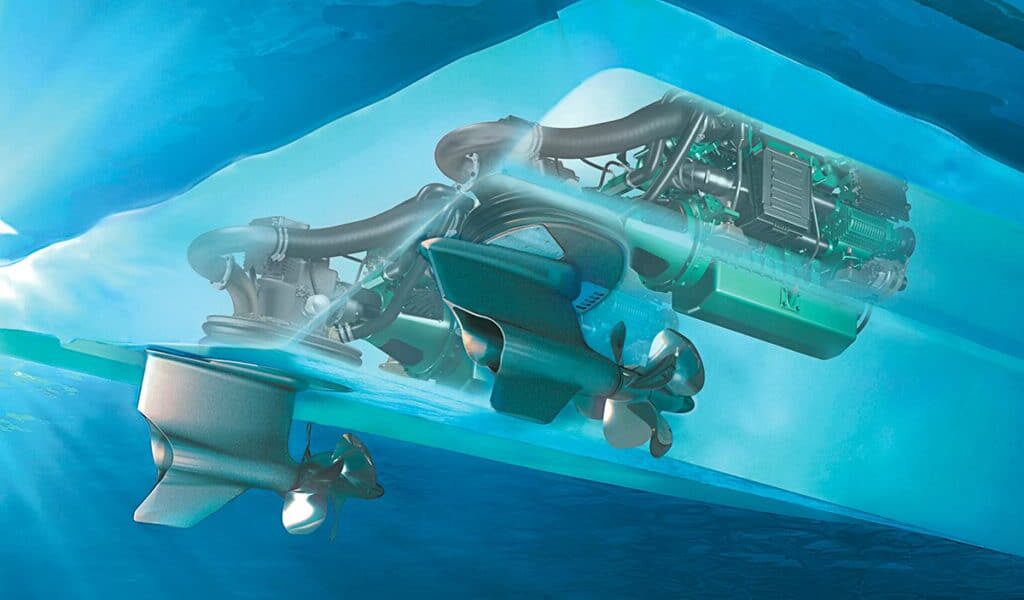
When Volvo Penta introduced IPS (Inboard Performance System) in 2005, they changed yacht propulsion forever. Pod drives—with forward-facing propellers mounted beneath the hull—deliver efficiency, maneuverability, and space savings that traditional shaft drives simply can’t match.
How Pod Drives Work
Unlike conventional inboards that direct thrust through propellers mounted behind the hull on angled shafts, pod drives mount the propellers directly beneath the boat on steerable pods. The engine connects to the pod through a rigid leg rather than a driveshaft.
Forward-facing, counter-rotating propellers pull the boat through undisturbed water rather than pushing through the turbulent flow created by the hull. This arrangement dramatically improves propulsion efficiency.
The pods themselves rotate for steering and reverse, eliminating the need for rudders, shafts, and conventional transmissions. Electronic controls manage all functions.
The Efficiency Revolution
Volvo Penta claims 15-30% fuel efficiency improvement over conventional shaft drives. Real-world experience generally confirms these figures, particularly at cruising speeds where the difference is most pronounced.
The efficiency gains compound: burning less fuel means carrying less fuel, which reduces weight, which further improves efficiency. Many yacht designers reduced tank sizes with pod installations, gaining interior space without sacrificing range.
Speed improvements accompany the efficiency gains. Boats with pod drives often achieve 1-2 knots higher top speeds than the same hull with conventional propulsion.
Maneuverability Transformation
Pod drives enable precision maneuvering that traditional systems can’t approach. The steerable pods can thrust in any direction, including sideways—a capability impossible with fixed props and rudders.
Joystick control integrates with the pod systems to deliver intuitive boat handling. Push the joystick left, and the boat moves left. Twist it, and the boat rotates in place. Combinations produce diagonal movements and complex maneuvers that previously required expert skill.
For novice operators, joystick docking transforms the most stressful part of boating into something approachable. For experienced captains, it enables precise positioning in tight quarters that would be impossible otherwise.
Space Below Decks
Traditional shaft drives require significant engine room length for shafts, struts, and related equipment. Pod drives mount the engine vertically over the pods, typically requiring half the longitudinal space.
Yacht designers use this recovered space for additional staterooms, larger engine rooms that are easier to service, or simply better-proportioned interiors. The impact on mid-size yachts is particularly significant.
Reduced Vibration and Noise
Forward-facing props in clean water produce less vibration than conventional installations. The counter-rotating arrangement further reduces torque-induced vibration.
Many pod-equipped boats achieve remarkably quiet operation at cruise. Owners frequently comment on the reduction in vibration and noise compared to conventional boats they’ve previously owned.
Installation and Service
Pod drives require specialized installation and service—this isn’t equipment for backyard mechanics. Factory-trained technicians perform installation, and warranty depends on proper dealer service.
Service access varies by installation. Some yacht designs provide excellent engine room access to pod components; others require more intrusive procedures.
Replacement parts and service are available through dealer networks, but remote cruising in areas without Volvo or other pod-system support requires careful planning.
Costs and Considerations
Pod systems typically add 20-30% to propulsion costs compared to conventional shaft drives. The premium reflects sophisticated engineering and electronics.
Operating costs may offset purchase premium through fuel savings, though this calculation depends on actual usage patterns. High-use boats see the best return on the efficiency investment.
Complexity concerns are valid—pod systems have more sophisticated electronics than traditional setups. However, reliability has proven generally excellent, and manufacturers continue improving product robustness.
Alternative Systems
Mercury’s Zeus and Yamaha’s Helm Master provide similar capabilities through different engineering approaches. Competition has improved all pod-drive options and expanded the range of available power levels.
Outboard joystick systems deliver some of the same maneuverability benefits for smaller boats, though the underlying technology differs substantially.
Who Benefits Most
Pod drives make the most sense for boats over 35 feet where the space savings and efficiency improvements justify the cost premium. Owners who value easy docking, quiet operation, and fuel efficiency find the technology compelling.
Traditional shaft drives remain appropriate for simple, lower-cost installations; boats in service areas without pod-system support; and owners who prefer systems they can service independently.
The Future of Propulsion
Pod drives have fundamentally changed yacht design and operation. Twenty years after introduction, they’re the default choice for many builders’ mid-size and larger models. The technology continues evolving, with hybrid-electric versions now emerging.
For buyers considering new yachts in the appropriate size range, pod drives deserve serious consideration. The efficiency, maneuverability, and space advantages represent genuine progress in marine propulsion—evolution that benefits everyone who operates these boats.

Stay in the loop
Get the latest power and motor yacht central updates delivered to your inbox.