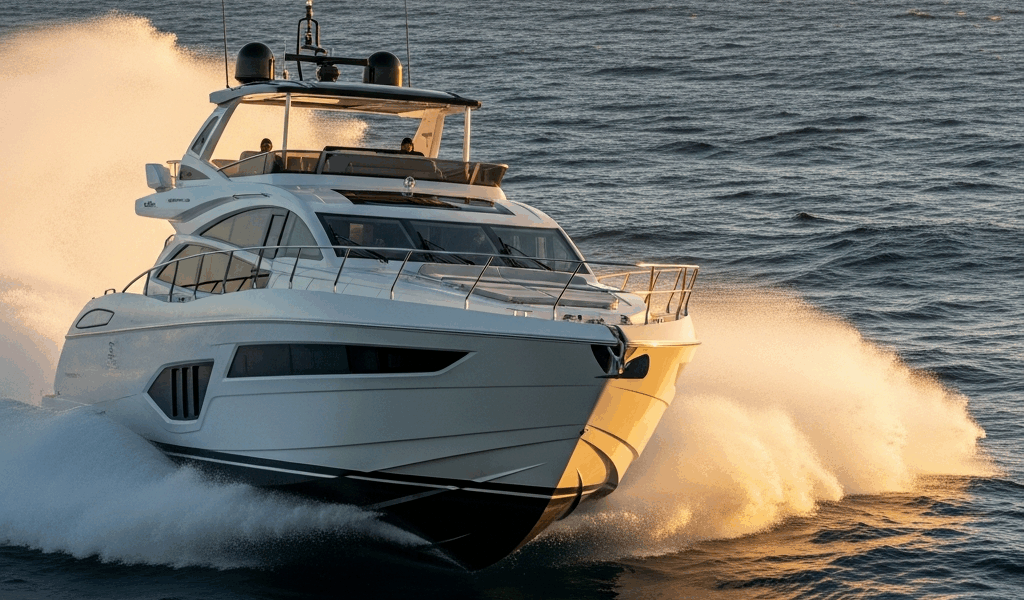
Who Actually Buys the Predator 130
Yacht buying has gotten complicated with all the glossy marketing noise flying around.
These aren’t first-timers kicking tires. The buyers stepping aboard a Sunseeker Predator 130 have typically spent a decade or more running 90 to 100-foot platforms. They know displacement hull behavior in a swell. They understand fuel burn math. They’ve already survived crew drama in tight quarters. Five years of that education, sometimes fifteen.
Geographically? UK and Mediterranean money, mostly — or US East Coast. Ages 50 to 70. Self-made more often than inherited, which matters enormously because self-made buyers think operationally, not romantically. Weekend Med runs. A two-week summer circuit through Croatia or the Greek islands. The occasional transatlantic delivery when fuel prices and schedules cooperate simultaneously. Speed is a priority. Style is a bigger one — though the spouse usually has a conflicting opinion about that hierarchy.
That’s what makes the Predator 130 endearing to us experienced operators. A 45-year-old broker running a demo focuses on acceleration curves and salon finishes. A 62-year-old owner who plans to hand-steer eight consecutive hours? They’re listening for something entirely different. That difference shapes every honest review of this boat.
What the Sea Trial Does Not Show You
Probably should have opened with this section, honestly.
Engine room noise at cruise power settings penetrates the main saloon more aggressively than Sunseeker’s marketing team would prefer you know. At 2200 RPM — which is exactly where you’ll live during fuel-conscious cruising — the vibration through the sole is noticeable. Not alarming. Not a deal-breaker. But put a Princess Y85 or a Ferretti 780 back-to-back with this boat and you’ll feel the difference immediately. Both competitors isolate engine noise better. Full stop.
The specification sheet claims 2,100 nautical miles at 75% cruise power. Real-world numbers run closer to 1,650 to 1,750 miles under mixed conditions — shallow Mediterranean harbor speeds, open-water transits, and the inevitable throttle-back when a fishing fleet materializes across your heading. That gap isn’t unique to Sunseeker. It’s an industry-wide habit. But know it before you commit to a transatlantic crossing or plan a season where fuel stops have scheduling consequences.
Beam sea behavior also diverges sharply from flat-water demos. Frustrated by secondhand accounts that never quite matched reality, I learned what the Predator 130 actually does in waves by running headlong into a legitimate north wind off the Tyrrhenian Sea. The hull dynamics are solid — no surprise given Sunseeker’s pedigree — but this boat prefers a following or quartering sea. Into a true beam swell at 15 knots, a rhythmic roll builds if you hold full cruise power. You’ll back off. Any smart skipper would. That backoff stretches real passage times by 8 to 12 percent in honest conditions.
The helm station looks ergonomic. Feels inviting on a two-hour demo. Six hours in? Different story. The seat height relative to the wheel diameter runs slightly off for operators over six feet — I’m apparently 6’1″ on a good day, and every other production helm I’ve run worked fine while this one never quite did. After four hours, your shoulder starts filing complaints. Visibility aft is good. Forward visibility is compromised by the hardtop and windscreen angle — acceptable, not exceptional. Don’t make my mistake of dismissing helm ergonomics as a minor detail during the sea trial. On a 130-footer that performs this well, you will spend real hours behind that wheel.
Crew Quarters and Operational Realities
But what is the Predator 130 at its core? In essence, it’s a performance cruiser built for aggressive passage-making and visual impact. But it’s much more than that — it’s a working platform that reveals its character over weeks, not hours.
The forward cabin sleeps two in a genuine queen-size bunk. Headroom hits 6’2″ — adequate. The aft crew quarters run roughly 10 feet 6 inches by 8 feet with a single pilot berth. Tight. Manageable for a weekend. After ten days of a two-week charter with a captain and one crew member, that space starts feeling like a storage locker that someone made a hasty decision about.
Galley counter space is functional but not generous. If you’re provisioning for six guests plus crew for a full week, expect to spend the first loading morning reorganizing where things physically fit — because your mental map from the brochure won’t match reality. Refrigeration capacity across two units sits at roughly 8.5 cubic feet. Handles ice and fresh provisions reasonably well, forces hard choices on extended offshore runs. The microwave-oven combo helps, though most charter guests honestly couldn’t care less about oven capacity.
The single-staircase layout surprised me operationally — specifically how fast it becomes an issue. Moving provisions, managing crew shift transitions, or getting four people topside quickly when someone needs medical attention reveals exactly why larger yachts run multiple companionways. It’s a deliberate tradeoff, not a design oversight. On a 130-footer optimized for speed and profile, you accept certain compromises. Just accept them knowingly.
One specific frustration: the crew cabin has no independent ventilation control. When the main saloon air conditioning runs during the day while crew tries to rest below, temperature management feels governed by luck. A dedicated crew cabin split unit runs roughly €8,000 to €12,000 installed as a retrofit. Most owners skip it. Crew rest cycles around owner schedule rather than optimal recovery. That’s the unwritten operational reality.
Tender Garage: What Fits and What Does Not
So, without further ado, let’s dive into the section that separates marketing fiction from purchasing reality.
The tender garage specs out at 23 cubic meters. Sunseeker’s literature implies a Williams 345 Turbojet fits comfortably. Technically accurate. Practically? Not once you factor in davit operation for short-handed maneuvering — which is how most owners actually deploy tenders in real life, not during supervised demos.
A Williams 325 or Novurania 430 works without modification. Single-handed davit winch operation, no excessive strain. A 345 is doable if you’re patient and deliberate about it. A jet ski — almost every prospective owner asks — occupies the same real estate that either your tender or guest luggage will claim. Not both. Budget for one or the other before you sign anything.
While you won’t need davit expertise from day one, you will need a handful of deliberate practice runs before tender deployment feels natural. Figure 15 to 20 deployments before the operation stops feeling stressful. A crew member or mechanic with prior davit experience on that first season shortens that curve considerably and prevents the jerky, stress-inducing drops that damage tender gear and corrode fittings over time.
The garage door mechanism is electric and reliable — right up until weather gets serious. In legitimate seaway conditions, standard heavy-weather cruising rather than emergency scenarios, that tender should already be on davits and secured. Not sitting in the garage where movement loads the door mechanism in ways it wasn’t engineered to handle repeatedly.
Is the Predator 130 Worth the Price in 2025
New Predator 130 pricing runs €5.2 to €5.8 million depending on specification package and yard location. Used 2019 to 2021 models come in at €3.5 to €4.2 million. The honest comparison set lives in Ferretti 780 and Princess Y85 territory — both well-regarded platforms at comparable price points, both worth genuine consideration.
The Predator 130 wins on speed and visual identity. It will outrun the Ferretti and the Princess. Hull lines and superstructure styling are aggressive and contemporary — subjective, but unmistakably intentional for buyers who see the yacht as personal expression rather than floating infrastructure.
The Ferretti 780 might be the better option for offshore-focused owners, as extended passage-making requires resilience in rougher conditions. That is because the Ferretti’s more conservative design handles beam seas and transatlantic work with noticeably more composure. Superior crew quarters and better galley workflow are real advantages over weeks, not hours. The Princess Y85 splits the difference — better interior livability than the Predator, more conservative styling, less outright speed but improved stability characteristics that older skippers genuinely appreciate.
First, you should honestly assess your intended usage — at least if you want to avoid a €5 million mistake. The Predator 130 rewards experienced operators who prioritize performance and visual statement. It punishes owners planning extended continuous cruising on tight fuel budgets or crews living aboard for months at a stretch. The boat demands aggressive maintenance protocols and mechanically-engaged ownership. If your habit is outsourcing all technical concerns to a captain, the Predator’s systems complexity will frustrate you faster than you expect.
In 2025, it’s fairly valued relative to peers. Not a bargain. You’re paying a premium for performance signature and styling — and that premium is justified if those attributes match your actual usage. That same €5 million buys superior interior volume and operational flexibility in other marques if space and range matter more than speed. Know which buyer you actually are before committing. This boat makes that question unforgiving.


Stay in the loop
Get the latest power and motor yacht central updates delivered to your inbox.