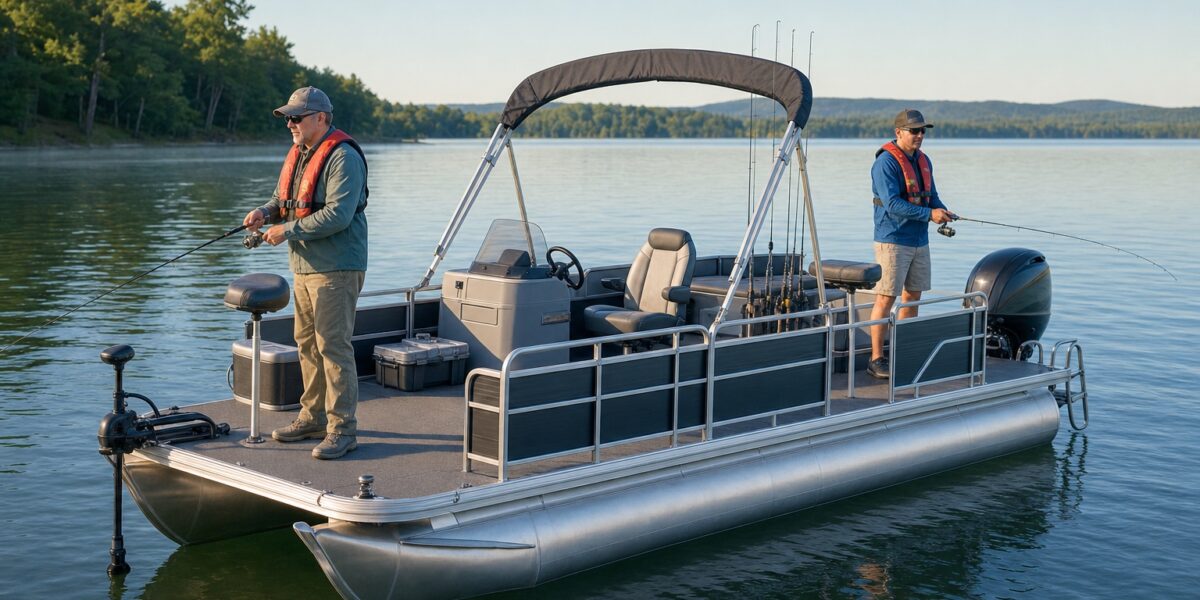
Fishing pontoon boats trade the narrow casting deck of a conventional fishing boat for a wide, level platform with room for anglers, family members and gear. The best choice is not simply the pontoon with the most seats or horsepower. It is the model whose fishing layout, payload, power, trailer and water-use limits match how you actually fish.
This guide compares current 2026 examples using manufacturer specifications and explains what to inspect before buying. Prices and equipment were checked in July 2026 and can change; photos on manufacturer sites may show optional equipment.
Fishing pontoon boats at a glance
| Current example | Length | Capacity | Power range or maximum | Best fit |
|---|---|---|---|---|
| Sun Tracker Bass Buggy 16 XL Select | 18 ft 5 in | 7 people | 50 hp maximum | Compact, lower-cost lake fishing |
| Sun Tracker Bass Buggy 18 DLX | 20 ft | 8 people | 75 hp maximum | More deck, fuel and livewell capacity |
| Lowe SF 212 | 22 ft | 10 people with standard tubes; 13 with TL package | 60–150 hp | Rear fishing station with forward lounging |
| Lowe SF 214 | 22 ft | 11 people; 13 with TL package | 60–150 hp | Four-corner fishing layout |
| Bennington S-One Fish | 18 or 22 ft configurations | Verify by exact build | 90–150 hp depending on layout and tube package | Customizable fishing and family use |
| Starcraft EXS Fish | Verify selected EXS Fish layout | Verify by exact build | Up to 300 hp in the EXS series | Premium tritoon performance with a fish layout |
Do not compare these rows as if they were identical packages. Twin-tube and triple-tube configurations, engines, trailers and option groups can change capacity, weight, handling and price.
What makes a pontoon genuinely fishing-ready?
Many pontoons can carry rods, but a purpose-built fishing layout makes a long day substantially easier. Look for:
- Pedestal fishing seats: Seats at the bow, stern or all four corners give anglers casting room outside the main lounge.
- A properly plumbed livewell or baitwell: Confirm capacity, aeration, drain routing and access. The label “fishing package” does not guarantee the system suits your target species.
- Secure rod storage: Check the longest rod each locker accepts and whether rods remain protected while trailering.
- Usable rail or track mounting: Rod holders should be positioned without interfering with gates, covers, seating or docking lines.
- Electronics space: The helm needs room, wiring access and electrical capacity for the display and transducer system you intend to use.
- Trolling-motor provision: Inspect the bow mounting surface, shaft-length requirement, battery location, charging access and cable path.
- Washable flooring and drainage: Carpet-like comfort can conflict with bait, mud and fish cleanup. Test how water exits the fishing areas.
The Recreational Boating & Fishing Foundation also recommends prioritizing rod holders, a livewell or baitwell and a bow-mounted electric motor when evaluating pontoon fishability.
Current 2026 fishing pontoon examples
Sun Tracker Bass Buggy 16 XL Select
The 2026 Bass Buggy 16 XL Select is the compact entry point in Sun Tracker’s fishing lineup. The manufacturer lists an overall length of 18 feet 5 inches, a 7-person capacity, a 50-hp maximum, a 9-gallon fuel tank and a 1,310-pound average dry weight. Standard fishing-oriented features include two folding fishing seats, a forward 9-gallon aerated livewell and a rod holder at the driver console.
Sun Tracker listed a national base price of $19,795 and a promotional price of $19,019 when checked in July 2026, both with a Mercury 20-hp outboard and excluding an optional trailer. That price is a starting configuration, not an out-the-door number.
Choose it when: you fish protected lakes, normally carry a small group and value easier storage and towing over maximum deck space.
Sun Tracker Bass Buggy 18 DLX
The 2026 Bass Buggy 18 DLX grows to 20 feet, eight people and a 75-hp maximum. Sun Tracker lists a 32.1-gallon fuel tank, three swiveling fishing chairs and both forward and aft livewells. The larger fuel capacity and two fishing decks make it a more flexible fishing-first package than the smaller 16 XL.
The published national base price was $27,995, with a $27,219 promotional price when checked, paired with a Mercury 40-hp outboard and excluding the optional trailer. Price the engine upgrade you need rather than assuming the base engine will deliver the acceleration or loaded performance you expect.
Choose it when: the compact model feels crowded with your normal crew and gear, but you still want a manageable fishing pontoon rather than a large tritoon.
Lowe SF 212 and SF 214
Lowe’s 22-foot SF models combine fishing stations with family seating. The SF 212 uses a rear fishing arrangement with forward lounging. Lowe lists a 60–150-hp range, capacity for 10 people with the standard configuration or 13 with the TL package, and a July 2026 starting price of $39,703 with a Mercury 60-hp outboard.
The SF 214 is also 22 feet with a 60–150-hp range. Its four-point fishing layout provides fishing positions around the boat, plus livewells, vertical rod holders and tackle storage. Lowe listed 11 passengers in the standard configuration or 13 with TL, and a starting price of $40,271 with the Mercury 60-hp outboard.
Choose the SF 212 when a defined rear fishing zone and forward social area match your crew. Choose the SF 214 when anglers need access at all four corners. Verify the exact tube package because it affects capacity and performance.
Bennington S-One Fish
Bennington’s S-One collection includes Fish layouts in 18- and 22-foot configurations. The manufacturer describes standard rod storage on S-One fish models and offers twin-tube or SPS triple-tube packages, with 90–150 hp depending on layout and tube configuration. The S-One collection started at $28,403 when checked, but that is not a guarantee for every Fish build.
Bennington’s broader fishing layout can include four fishing seats, a dedicated fish station and a livewell. Use the builder or dealer worksheet to identify the exact hull, layout, engine, fishing equipment and capacity plate behind a quote.
Choose it when: upholstery, family comfort and configuration flexibility matter as much as a dedicated fishing setup.
Starcraft EXS Fish
Starcraft offers a Fish layout in the EXS series. The EXS is a performance-oriented line with a standard HMX third-tube package; the series reaches a 300-hp maximum, while the current Fish layout showed a $63,611 starting price when checked. Exact length, capacity and rated horsepower depend on the selected configuration, so confirm the build sheet rather than applying series-wide limits to every boat.
Choose it when: you want fishing positions within a premium tritoon platform and are prepared for the additional engine, trailer, fuel and storage costs.
Twin tubes or a tritoon?
A conventional pontoon uses two tubes. A tritoon adds a center tube and often supports more power and a different performance envelope. The correct decision depends on the manufacturer’s complete package—not the tube count alone.
- Twin-tube advantages: generally lower purchase price, lower weight, simpler towing and sufficient performance for protected-water fishing at moderate speeds.
- Tritoon advantages: higher available power, stronger loaded performance and better support for cruising or tow-sports in models engineered for it.
- Tritoon tradeoffs: more purchase cost, fuel, weight and trailer demand. It does not turn a pontoon into an offshore fishing boat.
Pontoons are most at home in protected water. Wind acts on the large fence and canopy area, and short steep waves can make the ride wet or uncomfortable. Match the boat to the largest conditions you realistically expect, not the calm test-ride afternoon.
How much horsepower do you need?
Do not select horsepower from boat length alone. Ask the dealer for an on-water demonstration with a realistic load and evaluate:
- time to accelerate with passengers, fuel, batteries and fishing gear;
- low-speed control around docks;
- cruise speed and engine noise at your preferred pace;
- turning behavior and propeller ventilation;
- range using the actual fuel capacity; and
- whether tow sports are genuinely part of the mission.
The capacity plate and manufacturer rating set the maximum; they do not say that the maximum engine is necessary. A base engine may be economical for a lightly loaded fishing boat, while a larger permitted engine can matter when the boat regularly carries a full crew.
Trolling motor, batteries and electronics
A pontoon’s high bow and wide deck can demand a longer trolling-motor shaft than a low fishing boat. Measure from the mounting surface to the waterline under realistic load, then follow the motor manufacturer’s shaft guidance. Confirm thrust, voltage, battery chemistry, breaker, cable gauge and charger as one system.
Plan battery weight as payload. Two or three trolling batteries, a starting battery, fuel, livewell water, anchors, coolers and tackle can consume capacity quickly. Our guides to fishing-boat trolling motors, trolling-motor batteries and the Garmin ECHOMAP cover those choices in more detail.
Capacity, weight and safety
Use the capacity plate for the exact boat. Count people by both number and combined weight, then include motor and gear as the plate specifies. A high seat count does not mean you can add unlimited batteries, fuel, livewell water and fishing equipment.
The U.S. Coast Guard states that recreational boats generally must carry a Coast Guard-approved wearable life jacket of the proper size for each person. Boats longer than 16 feet generally also need an approved throwable device, with limited vessel-type exceptions. Federal rules require children under 13 to wear an approved life jacket while underway unless below deck or inside an enclosed cabin; state requirements can differ. The Coast Guard recommends wearing life jackets while underway.
Keep gates latched while moving, stow hooks and rods away from walkways, and lower or secure the canopy as the manufacturer directs. Fishing from pedestal seats or leaning against gates while the boat is underway is unsafe.
Trailer and storage checks
A “trailerable” pontoon still needs a compatible tow vehicle, hitch, brakes, bunks, guides and storage space. Check the boat’s package weight rather than dry weight, then add options, fuel, batteries and gear. Measure total height with the canopy stowed and total length including the outboard and trailer tongue.
Before a trip, inspect tire load rating and pressure, bearings, brakes, lights, straps and the winch. See our boat-trailer maintenance guide for the recurring checklist.
What should an out-the-door quote include?
- exact model year, layout and tube package;
- engine model, propeller and rigging;
- trailer model, brakes and spare tire;
- trolling motor, batteries, charger, wiring and breaker;
- fish finder, transducer and installation;
- cover, canopy and storage accessories;
- freight, preparation and documentation fees;
- sales tax, registration and title fees; and
- warranty coverage and required service.
Compare complete configurations, not advertised base prices. A lower-priced boat that needs a trailer, larger engine, electronics and a trolling system may cost more than a better-equipped package.
Used fishing pontoon inspection checklist
- Inspect each tube, nose cone, weld and bracket for dents, cracks, repair evidence and corrosion.
- Check the deck underneath for rot, delamination, loose fasteners or damaged crossmembers.
- Test gates, rails, pedestal bases, seat frames and the canopy.
- Fill and operate livewells; inspect pumps, hoses, clamps, drains and leaks.
- Load-test batteries and inspect chargers, breakers, wiring and terminal protection.
- Operate the trolling motor through deployment, steering and every speed setting.
- Verify the engine’s identification, hours, maintenance records and cold-start behavior.
- Sea-trial the boat with a realistic load and test full steering travel in both directions.
- Match the title, hull identification number, engine serial number and trailer VIN.
- Have a qualified marine technician or surveyor inspect any boat whose condition or value justifies it.
Which fishing pontoon should you buy?
- Compact and budget-focused: start with the Bass Buggy 16 XL Select.
- Fishing-first with more room: compare the Bass Buggy 18 DLX with the Lowe SF 214.
- Fishing zone plus family lounge: consider the Lowe SF 212.
- Configurable comfort: build and price a Bennington S-One Fish.
- Premium tritoon performance: evaluate the Starcraft EXS Fish, including towing and storage consequences.
The best fishing pontoon boat is the smallest complete package that safely carries your real crew and gear, performs properly on your water and supports the fishing systems you will actually use. Test the layout with rods in hand, price the entire rig and insist on a loaded on-water demonstration before buying.



Stay in the loop
Get the latest power and motor yacht central updates delivered to your inbox.