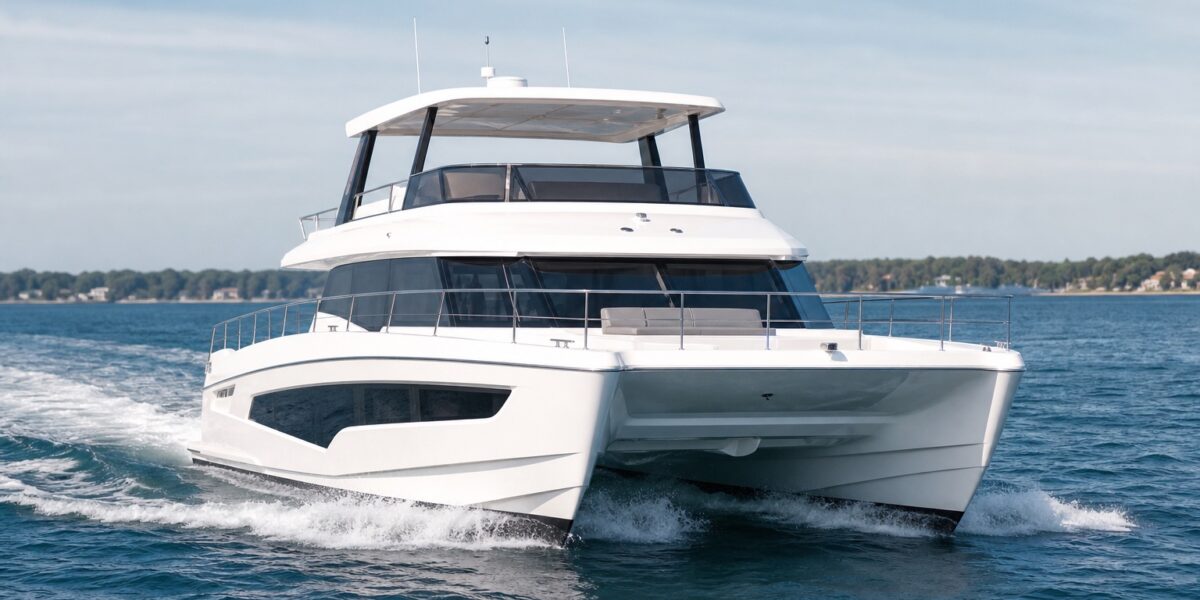
Aquila catamarans span four distinct powerboat families: Sport models for day boating and short overnights, Molokai models for fishing and offshore utility, Coupe models with a single-level social layout, and Yacht models designed for longer cruising. The right Aquila is not simply the largest one—it is the model whose beam, propulsion, sleeping plan, passenger rating and operating requirements fit the way you will actually use it.
This guide uses Aquila’s current model pages and published specifications, checked in July 2026. Dimensions, capacities, engines and availability can change by market and configuration. Confirm the exact build sheet, certification plate and sea-trial loading with an authorized dealer before purchasing.
This article includes affiliate links. We may earn a commission at no extra cost to you.
Current Aquila power catamaran lineup
| Family | Current models | Best starting point for |
|---|---|---|
| Sport | 32, 35, 36 and 45 | Day boating, entertaining, watersports and occasional overnight use |
| Molokai | 28, 28 Cuddy, 36 and 47 | Fishing, open-water utility and high-capacity outboard power |
| Coupe | 42 and 46 | Protected single-level living with inboard or outboard choices |
| Yacht | 42, 46, 50, 54 and 70 Luxury | Flybridge cruising, multiple cabins and longer stays aboard |
Aquila also lists a separate sail-catamaran range. Do not assume a specification, passenger capacity or offshore category from one family applies to another. The new 35 Sport is announced for arrival in September 2026, so availability and final market specifications deserve direct confirmation.
Representative Aquila models and specifications
| Model | Published size | Accommodation or capacity | Propulsion and fuel |
|---|---|---|---|
| Aquila 32 Sport | 32 ft 4 in long; 12 ft 8 in beam | One cabin and one head; passenger limit varies by certification category | Twin 225 hp standard, twin 300 hp optional |
| Aquila 35 Sport | 35 ft 6 in long; 14 ft 9 in beam | One cabin, one head; published maximum 24 people | Twin V8 300 hp standard or V10 400 hp optional; 396 gal fuel |
| Aquila 42 Coupe | 42 ft 10 in with outboards or 42 ft 3 in with inboards; 15 ft 11 in beam | Two cabins and two heads | Inboard or outboard configurations; 410 gal fuel |
| Aquila 47 Molokai | 49 ft 4 in overall; 14 ft 7 in beam | Cabin and head; published capacity 17 | Twin 600 hp or quad 400 hp outboards; 1,048 gal fuel |
| Aquila 46 Yacht | 47 ft 2 in long; 23 ft 3 in beam | Three-, four- or five-cabin layouts | Twin Volvo Penta D4 320 standard; 476 gal plus optional 211 gal fuel |
| Aquila 50 Yacht | 52 ft 2 in long; 25 ft 6 in beam | Three cabins plus utility room standard; optional four-cabin and crew arrangements | Twin Volvo Penta D6 380 standard |
These are planning figures, not substitutes for the model’s current specification sheet. For example, Aquila publishes different 32 Sport passenger limits for different CE design categories, and a fully loaded figure of 16,640 pounds. The 46 Yacht is published with CE categories ranging from A to D and different person limits in each. Offshore suitability must be evaluated for the exact boat, load, certification and conditions—not inferred from the brand name.
Aquila Sport: open-air day boating
The Sport line is the sensible place to begin when most use will be day trips, swimming, entertaining or watersports. The 32 combines an open bow, central social space and a small cabin/head package without the beam of the larger cruising cats. The 35 expands width and passenger space, while the 36 and 45 move farther toward substantial overnight capability.
Compare more than maximum horsepower. Check visibility at displacement and planing speeds, access around the outboards, boarding from the water, shade coverage, cooler and gear storage, and whether the cabin ventilation works at anchor. Run the sea trial at a realistic fuel, water, passenger and equipment load. An lightly loaded demonstration boat can feel different from the delivered boat.
Aquila Molokai: fishing and offshore utility
Molokai models emphasize working deck space, fishability and outboard performance. The 28 and 28 Cuddy are the smaller entries; the 36 adds range and capacity; the 47 pairs a narrow-for-its-length 14-foot-7-inch beam with up to quad 400 hp outboards and 1,048 gallons of fuel.
For a fishing build, inspect livewell and fish-box plumbing, pump access, rod clearance, tackle storage, transducer placement and the path from cockpit to bow. Calculate payload using people, fuel, water, ice, bait, batteries, safety gear and options. Published fuel capacity alone does not prove range: use measured consumption at several loaded speeds, retain a weather and reserve margin, and account for current, sea state and generator use.
Aquila Coupe: single-level protected living
The 42 and 46 Coupe models bridge day boating and cruising. Their defining appeal is an enclosed, climate-protected main level with broad visibility rather than a conventional flybridge arrangement. The 42 Coupe publishes two cabins and two heads, a 15-foot-11-inch beam and both inboard and outboard configurations.
A Coupe comparison should include docking visibility, airflow when the salon is open, engine-room or outboard service access, noise at cruise and the transition between cockpit, galley and helm. Price each propulsion choice as a complete ownership package, including haul-out access, local service availability and routine maintenance.
Aquila Yacht: flybridge cruising
The Yacht line begins with the 42 and progresses through the 46, 50, 54 and 70 Luxury. Wider beams create large salons and multiple cabins, but they also affect slip availability, travel-lift access and route planning. The 46 Yacht’s 23-foot-3-inch beam and the 50 Yacht’s 25-foot-6-inch beam should be checked against actual home-marina and service-yard limits before a deposit.
Aquila publishes estimated wide-open-throttle and cruise figures for the 50 Yacht—about 22 knots and 18–19 knots respectively—but labels them as estimates. Treat them as a starting point for a loaded sea trial, not a performance guarantee. Aquila lists optional solar and hybrid-support features for this model; that does not mean every Aquila is hybrid-powered.
What a power catamaran changes
A power catamaran uses two hulls separated by a tunnel. The wide stance can produce generous deck and interior volume, and twin hulls create separate machinery spaces on many models. That architecture also introduces practical tradeoffs:
- Beam: a wide boat may need a catamaran slip, end tie or special haul-out facility.
- Windage: tall cabin sides and flybridges can demand more planning in crosswind docking.
- Twin systems: separated engines and tanks can aid access or redundancy, but still require twice the inspections and coordinated maintenance.
- Tunnel behavior: wave angle, speed, load and bridgedeck clearance affect impact and spray. Evaluate it in relevant conditions.
- Loading: uneven stores, tanks or passenger distribution can alter trim and handling.
Our Deep-V versus catamaran hull guide explains the basic geometry, while the power-catamaran explainer distinguishes sail and power configurations.
How to choose the right Aquila
- Write a real use profile. Estimate annual day trips, nights aboard, fishing days, passenger count and expected routes.
- Set hard dimensional limits. Confirm slip width, length, water depth, bridge clearance, lift beam and yard capacity.
- Compare loaded boats. Include fuel, water, people, tender, batteries, electronics and cruising stores.
- Choose the layout before the décor. Test berth access, head privacy, galley workflow, ventilation, handholds and storage.
- Build a complete quote. Include engines, electronics, climate systems, generator, tender handling, commissioning, freight, tax and safety gear.
- Verify local support. Identify who will service the engines, electrical system, glazing, air conditioning and model-specific parts.
Sea-trial checklist
- Record fuel, water, passengers, gear and sea conditions.
- Observe acceleration, minimum planing speed and trim sensitivity.
- Run several cruise speeds and record engine data and measured fuel burn.
- Turn both directions, back down and test low-speed control in wind.
- Check visibility from every helm and blind spots created by passengers or canvas.
- Listen for tunnel impact, vibration, rattles and machinery noise.
- Test steering, trim, bilge pumps, navigation equipment, generator and climate systems.
- Inspect engine spaces immediately after the run for leaks, odors, heat or loose equipment.
Buying a used Aquila
A used purchase should include an independent marine survey and, where appropriate, separate engine diagnostics. Ask for hull identification, build sheet, ownership records, service invoices, software and equipment updates, grounding or storm history, and documentation for major repairs.
Inspect both hulls and the bridgedeck for damage or repair, then evaluate moisture, through-hulls, steering, fuel systems, batteries, shore power, bonding, sanitation, air conditioning and safety equipment. Our used-yacht survey red-flag guide provides a broader checklist. A survey reduces uncertainty; it does not eliminate the need to understand future maintenance.
Ownership costs to price before purchase
Do not use a single percentage of purchase price as a promise. Obtain local annual figures for the slip, insurance, scheduled engine service, haul-out, bottom care, cleaning, anodes, batteries and winter or storm storage. Add reserves for electronics, canvas, pumps, climate systems and unexpected repairs. A wide Yacht model may face different marina and yard costs from a 32 Sport even when both carry the same badge.
The complete boat-maintenance guide can help turn those systems into a calendar. Owners comparing a larger sailing-oriented platform can also read the large-catamaran cruising guide, but sail-catamaran performance and machinery assumptions should not be transferred to an Aquila power model.
Aquila catamaran buying checklist
- Which family—Sport, Molokai, Coupe or Yacht—matches the primary mission?
- Will the exact beam fit the home slip, lift and backup service yards?
- What certification category and capacity apply to the exact hull?
- What is included in the base boat, and what is optional?
- Does the sea trial represent realistic operating load and conditions?
- Can local technicians support the propulsion and onboard systems?
- Does the quote include commissioning, freight, taxes and required gear?
- For a used boat, are the surveyor and engine technician independent?
Start with the smallest family that meets the actual mission, then compare complete configurations rather than brochure length alone. The 32 Sport, 42 Coupe, 47 Molokai and 46 or 50 Yacht solve very different problems. A disciplined use profile, dimensional check, loaded sea trial and complete ownership budget will narrow the lineup far more reliably than generic claims about luxury or efficiency.


Stay in the loop
Get the latest power and motor yacht central updates delivered to your inbox.