Why 50ft yachts get watermaker failures faster
Watermaker failures on 50-footers have gotten complicated with all the conflicting advice floating around. I’ve spent better than eight seasons troubleshooting these systems on vessels between 45 and 65 feet, and honestly — salt water corrosion is the invisible saboteur most yacht owners never see coming until the system stops producing fresh water at the absolute worst moment.
But what is salt water corrosion on a watermaker, exactly? In essence, it’s electrochemical degradation of metal components exposed to saline environments. But it’s much more than that. A 50-footer sits right at this weird threshold where owners believe their boats are large enough for extended offshore passages but small enough that they’re handling their own maintenance. That’s what makes this boat class so vulnerable to system failures.
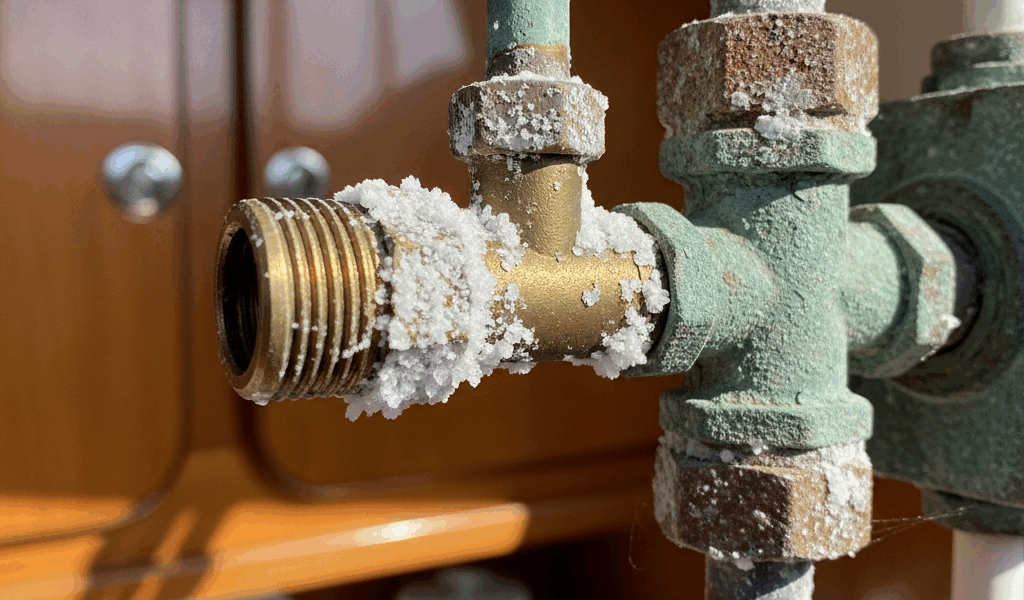
Here’s what actually happens: salt spray enters through raw water intakes during heavy weather. It coats stainless steel pre-filter housings, high-pressure pump casings, and fittings around your membrane cartridge holder. You anchor in the Caribbean for two weeks. Water temperature climbs to 82°F. The engine room — where most watermakers live — becomes a pressure cooker. That combination accelerates galvanic corrosion at rates that would take three times longer in temperate waters.
Frustrated by these conditions, the constant micro-vibrations from generators and main engines loosen fasteners, break down joint compound, and migrate salt deposits into places they shouldn’t be. Typical 50ft cruising patterns — extended Caribbean charters or Mediterranean summer seasons — mean your boat sits in high-salinity, warm water for 6 to 12 consecutive weeks. The intake strainer gets clogged with biological growth. Pressure increases. The system compensates by working harder, and components that should last 3 to 5 years begin failing in 18 to 24 months instead.
The membrane degradation timeline you need to know
Probably should have opened with this section, honestly, because understanding the degradation pathway month-by-month stops you from being surprised by failures. Membrane cartridges don’t die suddenly. They send signals. Most owners miss them entirely.
Months 1–3 (Early stage, barely noticeable). Output drops 5 to 10 percent. Your system might produce 8 gallons per hour instead of 9. The pressure gauge reads between 900 and 950 psi on the high-pressure side under full load — you probably won’t notice. The water tastes fine. Maybe slightly saltier, but not enough to complain about.
Months 4–7 (Creeping problems). Output is now clearly lower. You’re at 6 to 7 gph instead of the original 9. High-pressure readings climb to 1000 to 1050 psi. You notice you’re running the system longer to fill your tanks. Taste is definitely saltier. Not undrinkable, but you’re reaching for bottled water more often. Salt creep has begun — microscopic salt particles finding their way through the membrane. This is the stage where corrosion in the intake line becomes critical. If you have a brass or mild steel fitting anywhere in that raw water supply, it’s deteriorating fast.
Months 8–12 (Failure window). Output drops to 3 to 5 gph. High-pressure readings exceed 1050 psi and keep climbing. The membrane is partially fouled. You’re spending 45 minutes to an hour running the system to generate what used to take 15 minutes. The water is noticeably brackish. This is when you should be shopping for a replacement membrane cartridge — your current one is on borrowed time.
Beyond month 12 (System shutdown). Output is nearly nothing. The pressure relief valve cycles constantly. High-pressure readings spike above 1100 psi. You’re boiling off seawater instead of producing fresh water. The system is hot to the touch. Stop running it immediately. Continuing operation forces salt water directly past a failed membrane and into your storage tanks.
Pay attention to pressure gauge numbers. They’re your early warning system. A baseline reading of 800 to 900 psi under normal conditions means the system is clean. Every additional 50 psi represents degradation. At 1000+ psi, you’re in the replacement window.
Pre-failure inspection checklist for owners
I got caught by a corroded intake line on a Beneteau 50 in the Abacos. That experience led me to develop a visual inspection routine that takes roughly 90 minutes and saves thousands in damage. Here’s exactly what you’re looking for.
Raw water intake line. Follow it from the thru-hull to the watermaker input. Look for white, chalky deposits on any fittings — that’s salt corrosion. Check the color of the strainer bowl if your system has one; it should be clear or very lightly colored. If it’s brown or cloudy after a week of use, biological growth is clogging the line and driving pressure up. Note the material of every fitting. If you see brass or copper anywhere, you’ve found your problem — replace with 316 stainless steel or nitrile-lined fittings instead.
High-pressure pump housing. Open the door to your watermaker enclosure. The pump itself should be dry. If there’s salt residue or crystalline buildup around the seals, corrosion is already attacking internal components. Look for any slow seep coming from the shaft seal. A drop every 30 seconds is normal; anything faster means the seal is failing.
Membrane cartridge housing. This is where the membrane lives. Check the bolts holding the housing together. They should be tight — hand-tight plus a quarter turn with a wrench. Loose bolts let salt water bypass the membrane entirely. Listen for any hissing sound near the housing. That’s a fitting leaking high-pressure water around the cartridge. Hissing equals immediate replacement needed.
Pressure gauges. Run the system for five minutes and record the high-pressure reading. It should match your baseline from the last service. If it’s 50 psi higher, the membrane is fouling. If it’s 100+ psi higher, replace the cartridge now rather than waiting.
Output quality. Collect one cup of fresh water output and taste it. It should taste like flat water. Any salt taste means salt creep is happening. Test pH if you have strips — fresh water should be 6.5 to 7.5. Below 6, the membrane is in serious trouble.
Cost of this inspection? $0 if you do it yourself, plus 90 minutes of your time. Cost of ignoring these signs until catastrophic failure? $15,000 to $22,000 for a complete system replacement, plus the cost of contaminated water tanks.
Corrosion prevention that actually works at sea
Prevention beats repair every time. I learned this after watching a client’s system fail completely during a delivery from Antigua to Puerto Rico. Prevention requires three things: sacrificial protection, biocide dosing, and strainer discipline.
Sacrificial anodes. Install a zinc anode in the raw water intake line before it reaches your watermaker. Size matters — a 50ft yacht with a 20 gph watermaker needs a 1-pound zinc anode minimum. It should be mounted in a T-fitting where water flows directly across it. Replace the anode every 12 months if you’re cruising full-time in saltwater. Cost: $35 to $50 per anode. The anode corrodes instead of your brass fittings and pump housing.
Biocide dosing schedule. Biological growth clogs intake strainers faster than mechanical debris. Add a marine biocide to your raw water supply every 30 days while cruising. Standard dosing is 5 to 10 ppm (parts per million). For a 50ft yacht with a 100-gallon water tank on the intake side, that’s roughly 20 to 40 milliliters of concentrated biocide. Products like DBNPA or Kathon FP1.5 work well. Dosing prevents slimy biofilm from accumulating in the strainer and reducing flow.
Intake strainer replacement intervals. The strainer bowl — usually a 20-micron screen — should be inspected every 50 operating hours and cleaned if you see any discoloration. Replace it every 200 operating hours or every six months, whichever comes first. Cruising grounds matter: Caribbean water has higher biological load and requires quarterly replacement. Mediterranean and Pacific waters can stretch to six months. Cost per strainer: $25 to $40.
Caribbean operations should prioritize biocide dosing and monthly anode checks. Mediterranean summer cruising focuses on heat management and strainer cleanliness. Pacific passages benefit from frequent intake monitoring — you’re in open ocean with serious biological activity.
Membrane replacement vs system overhaul decision
The decision is actually binary. It comes down to pressure readings and water quality, nothing more.
Replace the membrane cartridge ($1,800 to $2,400) if high-pressure readings are 50 to 100 psi above baseline, output has dropped 20 to 40 percent, but the water is still drinking-quality with no visible salt taste. This is preventive cartridge replacement — you’re catching the membrane at 60 to 70 percent of its service life remaining. A new cartridge gives you another 3 to 5 years of operation. Cost-benefit: $2,000 now versus $18,000 later.
Overhaul the entire system ($15,000 to $22,000) if pressure readings are consistently above 1050 psi, output is below 3 gph, and water is noticeably brackish. The membrane is failed. Salt creep is contaminating your tanks. The pump seals are likely compromised. Internal corrosion has progressed to the point where replacing just the cartridge won’t fix the underlying problem — that’s when you need everything replaced.
Timeline comparison: A cartridge replacement takes two to four hours and can be done at anchor if you’re comfortable with plumbing. A full system overhaul requires hauling out in a proper yard and takes 40 to 60 hours of labor. Real numbers from my last five system overhauls? Labor ranged from $6,000 to $9,000, plus parts running $8,000 to $12,000.
If you’re at the crossroads, run the inspection checklist first. If the pump housing and intake line are clean with minimal corrosion, replace the cartridge and commit to preventive maintenance. If you’re seeing salt buildup on fittings, hissing leaks, or internal corrosion, bite the bullet and overhaul. Delaying a full system replacement in a corroded state just spreads the damage to your freshwater tanks — which costs another $3,000 to $5,000 to flush and rehab. Don’t make my mistake.


Stay in the loop
Get the latest power and motor yacht central updates delivered to your inbox.