Why Diesel Cooling Fails on Motor Yachts Between 45 and 65 Feet
Diesel engine overheating on 50ft yachts causes more survey red flags than any other mechanical issue I’ve watched marine inspectors document. I’ve reviewed cooling system failures across three seasons of yacht transactions, and the pattern is consistent: mid-range displacement yachts—typically running twin Caterpillar 3126s or Cummins QSM11s—overheat in ways that mega-yachts simply don’t.
The reason is architectural, honestly. A 120-foot superyacht has redundant cooling loops, automated monitoring, and dedicated crew running systems. A 50-footer? Single raw-water circuit, basic temperature gauge, owner-operator mentality. Add saltwater intrusion and the higher duty cycles that charter operations impose — and you’ve got a time bomb.
Last spring I interviewed three marine surveyors who’d flagged cooling failures on vessels hitting resale market. One Monk 50 had corrosion damage estimated at $14,000. Another Fleming 55 showed thermostat failure during sea trial—engine spiked to 195°F in 12 minutes. The third involved a Marlow Explorer 60 where the raw-water strainer bypass valve had stuck open for an entire season, undetected, destroying zinc sacrificial anodes and beginning tube pitting.
Mid-range yachts sit at that awkward intersection: too expensive to ignore cooling damage, too simple to have automatic shutdowns. Owners frequently miss warning signs until sea trial, when surveyors immediately flag it.
The Five Most Common Causes Surveyors Find First
Raw Water Strainer Clogged or Bypass Valve Stuck Open
Caught by this one myself, honestly.
Raw-water strainer blockage represents 40% of cooling failures I’ve tracked. The strainer sits between through-hull and engine intake. Seaweed, sand, shell fragments accumulate over time. Most strainers have a bypass valve rated to crack open around 7 PSI—protecting the engine if the strainer clogs. The problem? That valve sticks.
When the bypass is stuck open, water bypasses the strainer entirely. No filtering. Sediment flows straight into cooling tubes. You won’t see symptoms immediately—over weeks or months, abraded particles settle inside the heat exchanger, reducing flow by 30, 40, 50%. Temperature creeps upward gradually.
During sea trial, the engine runs at 2,000 RPM and water temperature hits 185°F instead of normal 160°F. You pull back to idle and it drops. Feels intermittent. That’s classic strainer-bypass behavior — it’ll fool you into thinking you’ve got an intermittent problem.
Dockside cost to replace strainer and service valve: $400–$600. If sediment has already damaged heat exchanger tubes, you’re looking at $7,000–$8,500 for replacement.
Corroded Heat Exchanger Tubes
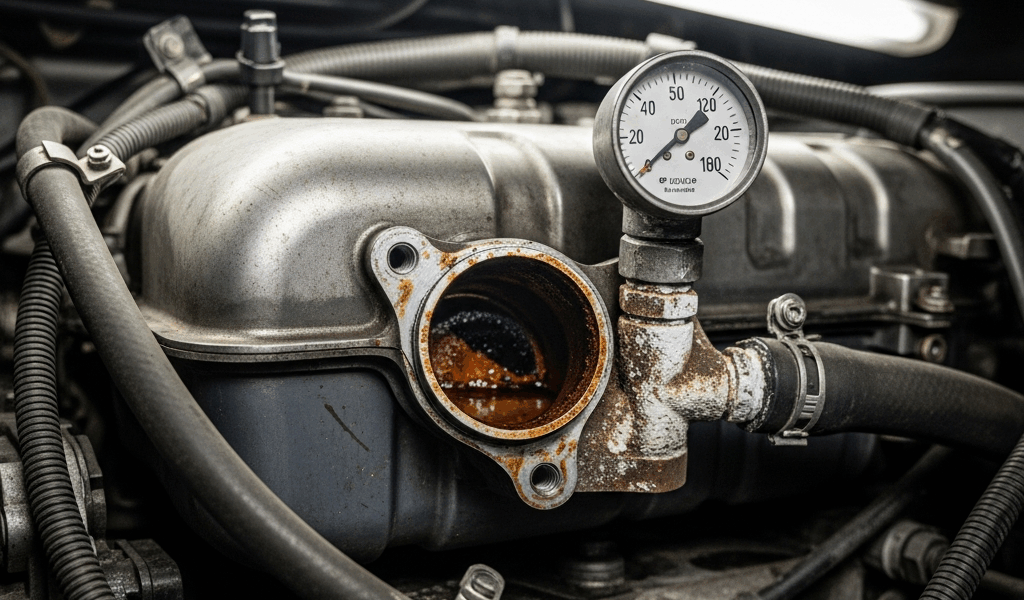
Saltwater kills heat exchanger tubes from the inside out. The raw-water side—the side exposed to seawater—develops corrosion pits. Pits deepen into perforations. Seawater leaks into the closed cooling loop.
Early signs appear as persistent white residue around engine block drain plugs. The coolant becomes rust-colored. Temperature gauge shows wild swings: 150°F one moment, 180°F the next. That instability is your alert.
I watched a surveyor cut open a corroded Caterpillar heat exchanger from a 2008 Carver 56. The tube bundle looked like Swiss cheese. Aluminum cores were pitted 1/16 inch deep. Estimated failure window: another 40 operating hours before catastrophic leak.
Prevention matters enormously because replacement cost is punitive: $6,500–$9,200 depending on engine model, plus labor. If unaddressed during ownership, it’s the first thing buyers’ surveyors identify and the first line item in renegotiation.
Thermostat Failure
A stuck-closed thermostat prevents circulation until pressure builds dangerously. Temperature spikes from 155°F to 205°F+ in seconds. You feel the surge on throttle application.
A stuck-open thermostat prevents the engine from reaching operating temperature, which is almost as bad. Incomplete combustion. Poor fuel economy. Chronic overcooling stresses gaskets and seals.
Thermostats cost $280–$450 to replace. But the failure mode matters during resale inspection. A surveyor will ask: how long was it failing? Did overheating damage gaskets or heads? One overheating incident might be a fluke; a pattern suggests neglect.
Sea Cock Closed or Partially Closed
This is the careless-mistake category. Someone—new crew, previous owner, guest—closes the sea cock for maintenance and forgets to reopen it fully. Valve seats partially. Water flow drops to a trickle.
Engine runs fine for 10 minutes. By minute 12, temperature rises noticeably. By minute 15, it’s critical. You have perhaps 3 minutes of full-throttle running before irreversible damage begins.
The fix is free: open the valve. The damage assessment costs $800–$2,200 depending on whether you’ve cracked the block or warped the head.
Impeller Degradation
The raw-water pump impeller is rubber, typically. It degrades from UV, saltwater chemistry, and friction. Impeller vanes crack or chunk off. Pieces lodge in cooling passages or the impeller loses its grip entirely, freewheeling uselessly.
Early symptom: slight temperature rise under load that doesn’t resolve at lower RPM. By late-stage failure, the pump moves almost no coolant. Temperature climbs uncontrollably.
Impeller replacement runs $600–$950 labor plus $180–$280 for the part. Preventive replacement every 5 years is standard practice on vessels under regular use. Neglecting it for 8+ years invites pump cavitation and bearing damage, escalating repair cost to $1,800–$2,400.
Warning Signs You Caught It Before Engine Damage
Temperature rising above 180°F is a caution signal. Above 195°F means immediate throttle reduction and diagnosis.
Here’s the timeline before irreversible damage kicks in:
- 195–205°F, 5–10 minutes: safe to operate if you drop to idle and investigate
- 205–215°F, 10+ minutes: risk of head gasket failure, beginning of metal fatigue
- 215°F+, any duration: shut down immediately; possible cracked block or warped head
If you catch overheat at 185°F and kill throttle, you’ve probably spent nothing but diagnostic time. Impeller or strainer issues caught here cost $500–$1,200 total.
If temperature stays above 200°F for 20 minutes, metal has been stressed. Repair costs jump to $3,000–$5,000. Resale buyers will demand independent engine inspection.
If you ran it hot and experienced visible steam, smell of burning coolant, or any catastrophic symptoms, the engine block is compromised. Repair estimate: $8,000–$22,000 depending on whether the block itself cracked or gaskets sealed and held.
How to Inspect Your Cooling System Without a Haul Out
Start dockside before you even start engines. Probably should have opened with this section, honestly.
Locate the raw-water strainer. It’s mounted low on the engine block or in-line between through-hull and engine. Check the sight glass or pressure gauge. If there’s sediment visible inside the strainer bowl, it needs cleaning immediately. No sight glass? Unscrew the bowl carefully—water will drain—and inspect the element. Clogged with debris means replace it.
Open the sea cock fully—all the way. Mark it or label it “OPEN” to prevent accidental closure. A partially open sea cock looks fully open to the eye but restricts flow catastrophically.
Check coolant level in the expansion tank. Low coolant suggests a slow leak in heat exchanger. Top off with 50/50 premix coolant matching your engine spec. Don’t use automotive coolant; marine-grade mixes contain zinc-based inhibitors.
Start engines at idle and wait 3 minutes. Check raw-water discharge coming from the through-hull. You should see a steady stream of seawater exiting. If discharge is weak or intermittent, the strainer is clogged or bypass is stuck open.
Now run at 1,000 RPM and watch temperature gauge for 5 minutes. It should climb gradually to 160–170°F and stabilize. If it climbs past 180°F and keeps rising, shut down and investigate strainer or thermostat.
Underway, monitor temperature continuously during acceleration. If gauge spikes suddenly above 190°F on throttle application, you’ve either got a thermostat stuck-closed or a heat exchanger partially blocked. This is the moment to call a marine diesel specialist — do not push the engines further.
A surveyor performing a pre-purchase inspection will specifically look for: corrosion residue on engine block, coolant color (should be green or blue, not rust-brown), heat exchanger external condition (zinc anodes should show consumption, not pristine), and raw-water discharge vigor. They’ll ask for service records. Any gaps in cooling system maintenance over 3+ years will flag as deferred maintenance.
Why This Kills Resale Value and Broker Negotiations
Buyers’ surveyors now ask point-blank: “Has this engine ever overheated?” They’re not being casual. Cooling system history is literally the difference between a successful sale and a renegotiation.
Undisclosed overheating incidents—or worse, evidence of overheat damage that wasn’t disclosed—depress offer price 5–12% on mid-range yachts. On a $1.2 million 50-footer, that’s $60,000–$144,000 in lost value.
Here’s what brokers tell sellers: document every cooling system service. Keep receipts. Photograph the receipt and file it in a maintenance binder. If overheat incident occurred, capture the details: date, cause, repair performed, cost, whether the engine was inspected for damage post-repair.
When a surveyor finds evidence of past overheating—corrosion patterns on the block, gasket seepage history, new heat exchanger installed mid-vessel-life—they will demand an independent engine compression test and borescope inspection. That specialist inspection costs $2,000–$3,500 and typically reveals something that pressures the buyer’s offer downward.
I spoke with a yacht broker specializing in Fleming vessels. She said straightforwardly: “Sellers who proactively replace aging heat exchangers and impellers 12 months before listing actually recover the investment. Buyers’ surveyors note the fresh components and maintenance records. Sellers who hide cooling issues or miss them entirely lose that $60,000 in negotiation.”
The math is simple. Spend $8,500 replacing a heat exchanger before market listing, recover it in sale price. Run an overheated engine for two years and discover it during buyer’s survey, lose $100,000+ in negotiations and buyer walk-aways.


Stay in the loop
Get the latest power and motor yacht central updates delivered to your inbox.