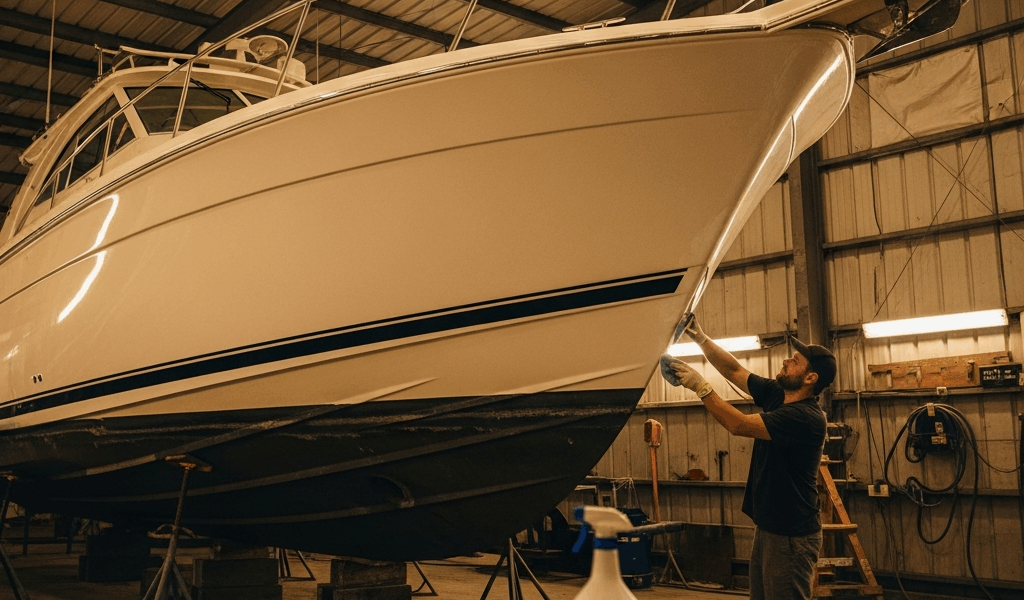
A marine ceramic coating can make gelcoat or marine paint easier to wash and help protect the finish from ultraviolet exposure, salt and environmental contamination. It is not a substitute for correcting oxidation, repairing damaged gelcoat or applying antifouling paint below the waterline.
There is no single “best” coating for every boat. The right choice depends on the surface, whether you are applying it yourself, the preparation the finish needs and whether you want a manufacturer-backed professional guarantee. This guide compares products using current manufacturer instructions and specifications—not invented field tests or paid rankings.
Quick answer: which marine ceramic coating should you choose?
- For a documented DIY system: Gyeon Q²R GelCoat is a one-layer coating made for gelcoat and yacht paint. Gyeon states a real-world lifespan of one to two seasons, consumption of 3–5 ml per square meter and a 48-hour water-free cure in its application manual.
- For a configurable base-and-top system: Gtechniq Marine Ceramic Base can be used alone or paired with Marine Ceramic Top. Gtechniq publishes a usage range of 5.5–7 ml per square meter for Base and offers both 50 ml and 250 ml bottles.
- For owners following a detailed marine-specific process: Glidecoat publishes step-by-step preparation, application and maintenance instructions for its Marine Ceramic Coating. Check the current kit size and coverage before ordering because surface porosity and the number of areas coated affect consumption.
- For a professional two-layer approach: Starke describes Repel Pro as the base layer in its marine system and Liquid THOR as the top layer. Follow the current Starke instructions rather than assuming one product or one coat completes the system.
These are selection categories, not independent durability rankings. Manufacturer claims are useful for compatibility and application planning, but conditions, preparation and maintenance determine what happens on an individual boat.
What a ceramic coating does—and does not do
A true coating is applied to a clean, prepared finish and cures into a thin protective layer. Manufacturers describe benefits such as water repellency, resistance to contamination, easier washing, gloss retention and protection from ultraviolet exposure. Those benefits do not make the coating armor.
A coating will not:
- remove oxidation, scratches, water spots or stains already in the finish;
- correct failed paint or cracked gelcoat;
- eliminate washing and periodic maintenance;
- make every surface safe to coat;
- replace antifouling paint on a hull that requires bottom protection; or
- guarantee a fixed lifespan regardless of climate, storage and use.
If the finish looks chalky after washing, correct the oxidation before coating. Ceramic products preserve the surface you give them; they do not restore a neglected surface by themselves. Start with a careful boat-cleaning process, then inspect the dry finish under good lighting.
Marine ceramic coating comparison
| System | Intended surface | Manufacturer-stated format | Important planning point |
|---|---|---|---|
| Gyeon Q²R GelCoat | Gelcoat and yacht paint | One-layer coating; 100 ml and 200 ml sizes | Gyeon specifies 3–5 ml/m² consumption and one to two seasons of real-world lifespan |
| Gtechniq Marine Ceramic Base and Top | Marine gelcoat and topcoat/paint | Base may stand alone or be paired with Top; 50 ml and 250 ml sizes | The professional guarantee has installer, registration and maintenance requirements |
| Glidecoat Marine Ceramic Coating | Use only on surfaces permitted by the current product instructions | Marine coating with published prep, application and care steps | Confirm current coverage and cure instructions for the exact product and bottle size |
| Starke Repel Pro system | Porous marine gelcoat, following Starke’s current process | Repel Pro base plus the manufacturer-recommended top layer | Do not treat a system product as a one-step spray sealant |
Prices are intentionally omitted because bottle sizes, kits and dealer-installed packages change. Compare the current product price only after calculating the area you plan to coat and every preparation product you need.
How the four systems differ
Gyeon Q²R GelCoat
Gyeon’s current product page identifies Q²R GelCoat as a coating for gelcoat and yacht paint. It lists 100 ml and 200 ml sizes, one-layer application, 3–5 ml/m² consumption and a real-world lifespan of one to two seasons. The official manual calls for washing, polishing as necessary, degreasing, working in controlled sections away from direct sun and keeping the surface away from water for 48 hours.
This is the clearest option here for an owner who wants published consumption and cure information. It is not automatically the cheapest choice: calculate surface area, account for waste and confirm that the finish is compatible before buying.
Gtechniq Marine Ceramic Base and Marine Ceramic Top
Gtechniq describes Marine Ceramic Base as a coating that bonds to gelcoat or marine paint. Its published usage is 5.5–7 ml/m², with actual consumption affected by the microporosity of the surface. The company says Base can be used alone, while adding Marine Ceramic Top increases hydrophobic and dirt-repellent behavior.
DIY application and a professional guaranteed installation are not the same purchase. Gtechniq’s guarantee terms require Base and Top to be applied by a certified marine detailer, timely registration and recurring documented maintenance. Read the current guarantee before comparing an installed quote with a bottle-only DIY price.
Glidecoat Marine Ceramic Coating
Glidecoat publishes a complete application sequence: wash and decontaminate, correct the finish, remove residue, apply a small amount to a limited working area, level it with microfiber towels and follow the stated cure and maintenance directions. The company also warns against stiff brushes and abrasive washing tools because abrasion reduces coating durability.
Glidecoat can suit an owner who is comfortable following a detailed process. Use the instructions for the exact current product rather than figures copied from an old review; Glidecoat offers multiple marine protection products, and their coverage and role are not interchangeable.
Starke Repel Pro
Starke positions Repel Pro as the foundation of a professional marine ceramic system for porous gelcoat. Its current application guide pairs that base with Liquid THOR as the top layer and calls for surface preparation, protective gloves, controlled sections and clean microfiber tools.
That makes Repel Pro a system decision, not a fair one-bottle comparison with a maintenance spray. Confirm the current application sequence, bottle requirement and installer recommendation directly with Starke before purchasing.
Ceramic coating versus wax
Wax and ceramic coating can both protect and improve the appearance of a prepared finish, but they have different costs and failure modes. Wax is generally easier to apply and correct. A ceramic coating asks for more exact preparation and leveling, but manufacturers design it for longer-lasting protection and easier cleaning.
Choose wax or a simpler sealant when:
- the boat is small enough that frequent application is not burdensome;
- the finish still needs correction and you are not ready to lock in the result;
- you cannot provide the required dry cure window;
- you want a forgiving process that is easier to redo; or
- the manufacturer does not approve your surface for the coating.
Consider a ceramic coating when the finish is already sound, you can complete the preparation and cure steps, and easier routine washing is worth the additional initial work. Do not justify it with a made-up five-year cost calculation. Price the actual surface correction, product quantity, applicators, towels, indoor or shaded work space and future maintenance.
Preparation determines the result
- Wash and decontaminate. Remove salt, grime, old protection and embedded contamination with products suitable for the surface.
- Inspect the dry finish. Look for oxidation, scratches, water spots, staining, failed paint and gelcoat damage.
- Correct defects. Compound and polish only as needed, using a process appropriate for the material and remaining finish thickness.
- Remove polishing residue. Use the coating manufacturer’s specified panel wipe or degreaser and clean microfiber towels.
- Control the environment. Work within the product’s temperature and humidity limits, away from direct sun, wind and spray.
- Apply small sections and level promptly. Flash and wipe timing varies by formula and conditions, so follow the exact instructions.
- Protect the cure. Keep the surface dry for the full period stated by the manufacturer.
If substantial oxidation or paint correction is required, a qualified marine detailer may be cheaper than correcting a failed DIY application. Add the coating to a broader boat maintenance plan rather than treating it as a one-time cure for finish care.
Can ceramic coating go below the waterline?
Do not assume an above-water coating is suitable for continuous immersion. The manufacturers compared here describe gelcoat, paint or topside protection and provide surface-specific instructions. A boat that needs fouling control should use an appropriate bottom-paint system below the waterline.
Props, shafts, trim tabs, glass, metal, vinyl and inflatable materials each present separate compatibility questions. Use only a product whose current documentation explicitly approves the material and exposure. A coating that works on gelcoat topsides is not automatically correct for aluminum, vinyl or running gear.
How much coating do you need?
Do not estimate from boat length alone. Measure the actual surfaces to be treated, then multiply by the manufacturer’s consumption rate. Add a reasonable allowance for applicator loading, porous gelcoat and learning loss, but do not invent a universal “one bottle per 30-foot boat” rule.
For example, Gyeon publishes 3–5 ml/m² for Q²R GelCoat, while Gtechniq publishes 5.5–7 ml/m² for Marine Ceramic Base. Those figures are not directly interchangeable: the formulas and application systems differ. Decks, hardtops, hull sides and superstructure also produce very different surface areas on boats of the same overall length.
Maintenance after application
- Rinse salt exposure with fresh water as soon as practical.
- Wash with the manufacturer-recommended or coating-safe cleaner.
- Use clean, non-abrasive wash media and microfiber towels.
- Avoid harsh chemicals, stiff brushes and aggressive polishing unless the coating maker permits them.
- Use only the compatible maintenance product specified for the coating system.
- Watch for reduced water behavior, contamination or isolated failure rather than assuming a calendar date proves the coating has failed.
Coating care is part of corrosion and finish care, especially in saltwater. Our guide to saltwater corrosion prevention covers the other systems that still need attention.
Decision checklist
- What is the exact surface: gelcoat, marine paint, aluminum, glass, vinyl or something else?
- Is the finish clean and defect-free enough to preserve?
- Does the manufacturer explicitly approve the surface and exposure?
- Can you meet the temperature, humidity and water-free cure requirements?
- How many square meters will you coat, and what consumption rate is published?
- Is the product a base layer, top layer, complete system or maintenance sealant?
- Does a guarantee require a certified installer and documented maintenance?
- Are you willing to maintain the coating with compatible wash products?
For most owners, the best marine ceramic coating is the system whose instructions match the boat and can be followed completely. Gyeon offers unusually specific DIY planning figures; Gtechniq provides flexible Base/Top options and a conditional professional guarantee; Glidecoat publishes a detailed owner application process; and Starke presents Repel Pro as part of a layered marine system. Verify the current label and instructions immediately before application.
Official product and application sources
- Gyeon Q²R GelCoat product information and official marine coatings manual
- Gtechniq Marine Ceramic Base instructions and marine guarantee terms
- Glidecoat Marine Ceramic Coating instructions
- Starke marine ceramic application guide
Product specifications and guarantees can change. This guide was checked against manufacturer materials in July 2026. It does not claim independent laboratory or on-water testing.




Stay in the loop
Get the latest power and motor yacht central updates delivered to your inbox.