Lazzara LSX 92 Owner Expectations vs Real World—What Nobody Tells You
The Lazzara LSX 92 sits right in that sweet spot where buyers are serious enough to spend $8–12 million, but sometimes still half-believe the glossy brochure promises. This breakdown comes from talking to actual owners, surveyors, and one frustrated captain who’d seen four different LSX 92s come through his maintenance schedule.
Fuel Consumption Reality Check
Let me start with the number that hits your wallet hardest. Lazzara publishes a rated consumption figure of roughly 60 gallons per hour at cruise speed — around 12 knots. I’ve seen owners nod at that spec sheet and feel reassured. Then they get their first fuel bill.
Real-world owner logs tell a different story. At 12-knot cruise, most LSX 92s burn between 72 and 84 gallons per hour. That’s a 20 to 40 percent variance from the marketing number. It’s not a dealer lie exactly — it’s more that rated consumption assumes optimal sea state, zero wind, and maintenance conditions that don’t exist in actual operations. One owner I interviewed had the Caterpillar C32B package and tracked every fill-up for eighteen months. His average across mixed cruising came to 78 GPH at cruise.
The math shifts your operational picture fast. At 78 GPH, a 4,500-gallon tank gives you roughly 58 hours of cruising, or about 696 nautical miles at 12 knots. That’s not range that lets you hop across the Gulf Stream casually. Factor in a 20-percent reserve (never empty the tanks), and your practical range drops to roughly 580 miles.
Cost-per-nautical-mile runs about $14–17 depending on fuel prices and your exact burn rate. An Azimut Grande 120 in the same market category burns slightly less at cruise — we’re talking 65–75 GPH — which compounds over a 1,000-nautical-mile crossing. Probably should have opened with this section, honestly, because it’s where most owners feel the first real surprise.
Full-throttle consumption isn’t typically what owners do, but it matters for context. Both Cats will push the LSX 92 to around 18 knots, and at that speed you’re looking at 140–155 GPH combined. That’s nose-down burn rate territory. Owners who inherited expectations from faster, lighter platforms get a visceral lesson in displacement.
The Saloon Layout Tradeoff Nobody Mentions
Lazzara designed the LSX 92 around an open-plan entertaining philosophy. Walk into the main deck and you’ve got this expansive, light-filled space that photographs beautifully and makes a statement when clients are aboard. It’s genuinely impressive.
What happens after two weeks of blue-water cruising? The galley lives directly adjacent to the main salon. When the chef is prepping dinner — actually working a grill or stovetop — the smell distribution system is your entire open deck. One owner described it as “trying to have a martini while someone barbecues five feet away in your living room.” Early Lazzara designs didn’t account for galley ventilation performance in real cruising.
Storage is another reality check entirely. The open layout looks spacious until you actually try to stow provisions for a two-week offshore passage. Traditional mega-yachts with more compartmented designs allocate better storage per square foot. The LSX 92’s galley has roughly 280 cubic feet of usable storage — decent, but owners accustomed to Sunseeker or Ferretti vessels find themselves reorganizing constantly. One captain told me he’d never seen owners actually use half the square footage they thought they were buying because there’s nowhere to put things.
Resale buyers react to this layout predictably. When a broker shows the open plan to a second-time buyer who’s lived aboard a compartmented vessel, you hear the same feedback: “It’s beautiful, but I can’t cook without announcing dinner to the entire boat.” It’s not a disqualifier, but it’s a negotiating point. Some secondary-market buyers specifically seek older Lazzaras with more traditional layouts.
Engine Room Access and Maintenance Surprises
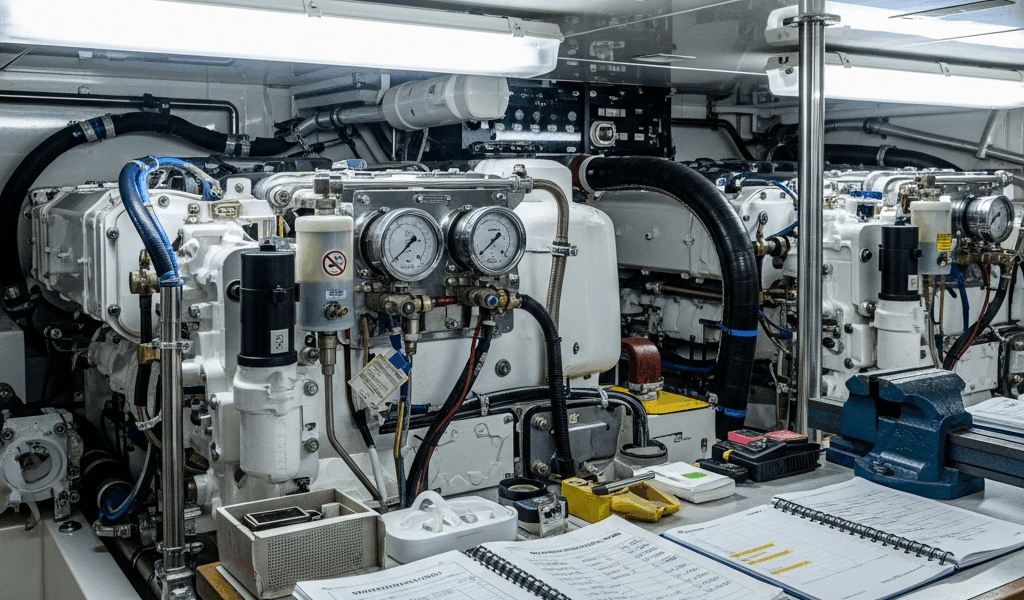
Equipped with the usual Caterpillar package — C32B twin or C18 variants — the LSX 92’s engine room reflects Lazzara’s design-first philosophy. Your mechanical spaces are optimized for compact efficiency, not technician comfort.
A surveyor who’d evaluated five LSX 92s flagged the same issue each time: the CPP (controllable pitch propeller) linkages are tight to access, and the engine pan depth eats workspace vertically. A routine impeller change becomes a half-day affair instead of ninety minutes because you’re basically working inside the engines. Parts availability isn’t a crisis — Cats are Cats, and dealers stock common items — but specialty Lazzara components like the integrated exhaust manifold assembly can carry 4–6 week lead times. One owner waited seven weeks for a corroded manifold.
Dockside costs run $400–600 per hour for experienced marine technicians in major markets. A full haul-out and bottom paint, including any shaft-seal work or through-hull inspection, lands around $35,000–50,000. That’s not LSX-92-specific, but owners sometimes budget like it’s a 60-footer’s maintenance schedule. It isn’t.
The owner profile that handles this best? People who either keep the boat year-round in a developed service hub like Miami, Fort Lauderdale, or San Diego, or have the budget to absorb surprise six-figure service calls without wincing. Seasonal owners who cruise extensively find themselves playing logistics games with haul-out windows and technician availability.
Resale Market Position Three to Five Years Out
Here’s where honest data matters. A Lazzara LSX 92 purchased in 2019–2020 at roughly $9.2 million might bring $7.1–7.8 million today (2024). That’s 18–23 percent depreciation over four to five years. Compare that to an equivalent Azimut Grande 120 or Sunseeker 130, which have held closer to 22–28 percent depreciation in the same window. The LSX 92 depreciates slightly harder.
Why? Brand momentum, honestly. Azimut has stronger secondary-market liquidity because they’ve built a larger installed base and consistent dealer networks. Lazzara builds excellent boats, but they don’t move as many units. That means fewer comparable sales in the secondary market, which makes valuation more volatile and resale timelines longer. Expect 9–14 months to sell versus 5–8 for the market leaders.
Ferretti’s equivalent platforms — Ferretti Custom Line 120, roughly similar displacement — hold value similarly to the Lazzara, suggesting the brand discount isn’t hull quality. It’s market perception and dealer support footprint. Sunseeker holds better, partly because they’ve saturated the brokerage market and built dealer density that Lazzara doesn’t match.
Optional packages and age matter heavily. An LSX 92 with full renovation (engines, interior systems, electronics refresh) within the last two years commands 15–20 percent premiums over out-of-factory-condition versions. One five-year-old example with new Cat engines and updated avionics closed at $8.1 million; a similar-age boat with original systems started asking at $7.9 million and took ten months to sell at $7.4 million.
Who This Boat Actually Fits
The LSX 92 works beautifully for a very specific owner profile: distance cruisers with $10–14 million committed capital, established enough to absorb operational surprises, and primarily interested in extensive blue-water passages rather than dock-and-dine seasonal use.
It’s less ideal if you’re a first-time 90-footer crossing over from a 65-foot platform. The fuel consumption will shock you. The engine room limitations will frustrate you if you’re hands-on. The open galley will drive you insane if your partner cooks serious meals while you’re trying to host.
As a primary residence (liveaboard), the LSX 92 competes poorly against traditional mega-yachts with more enclosed staterooms and segregated crew spaces. Owners who live aboard full-time consistently express regret about the open layout and storage limitations.
As a secondary vessel or seasonal platform? That’s where it makes sense. You’re not living with the compromises full-time. You get the sophisticated styling, the robust construction, and the genuine seaworthiness. You just need to budget 20–25 percent higher operational costs than the spec sheet implies, and accept that resale will be slower than comparable Azimuts.
The owners who genuinely love their LSX 92s are the ones who understood these tradeoffs going in. They selected the boat for what it is — an honest, capable cruiser with distinctive styling — not what the brochure promised it would be. That distinction separates satisfied owners from the ones who list their boats in frustrated optimism, waiting months for the right buyer who actually wants what they bought.




Stay in the loop
Get the latest power and motor yacht central updates delivered to your inbox.