Why 50ft Motor Yachts Smell Worse Than Larger Yachts
I spent three seasons managing a 52-foot Azimut before everything clicked. The holding tank odor problem on these mid-size motor yachts? It’s fundamentally different from what cruisers deal with on 70-footers or larger vessels. Most people blame laziness or poor maintenance. The real culprit is physics.
Here’s the math that nobody talks about. Most 50ft motor yachts carry between 75 and 150 gallons of black water capacity. Reasonable on paper — until you realize that even moderate weeklong cruising fills that tank to 60 percent capacity. Take an 80-footer with 300-gallon tanks and the same usage pattern leaves you at 30 percent. The concentration difference? It matters enormously.
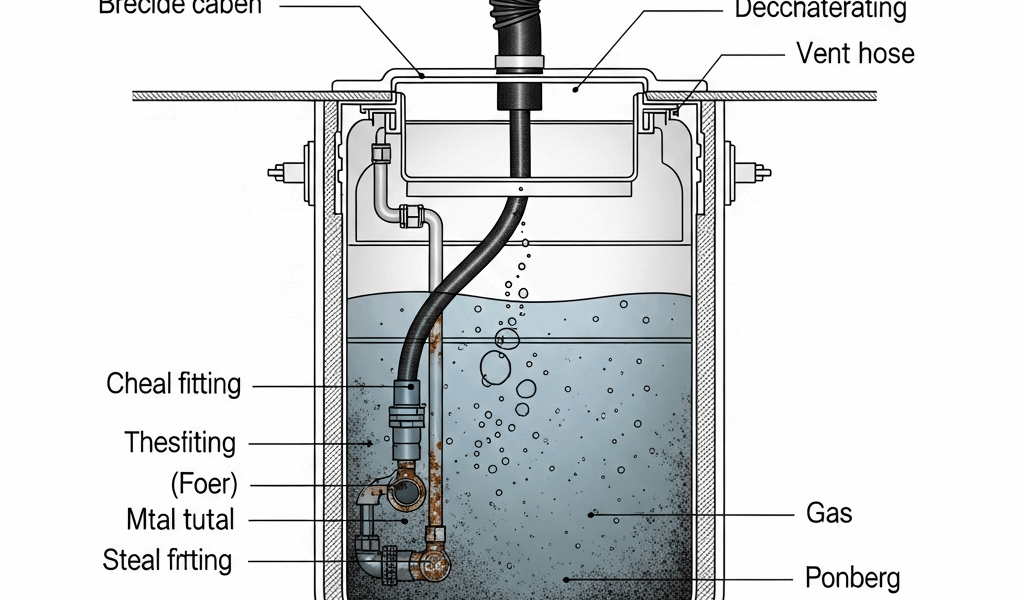
Those mid-size hulls were designed in the 1990s and 2000s with ventilation duct sizing that’s barely adequate. The vent lines — typically 1.25 inches in diameter — run from the tank through the cabin structure and exit above the waterline. Tight cabin designs mean those ducts take convoluted paths. I measured one owner’s vent line that literally made three ninety-degree turns through the engine room before reaching open air. That’s throttling the escape velocity of decomposition gases.
Tank geometry accelerates biofilm buildup in ways people don’t expect. Cylindrical tanks on 50-footers often sit low in the bilge with dead zones where water motion during cruising doesn’t reach. Anaerobic bacteria — the ones that produce hydrogen sulfide and that rotten-egg smell — thrive in those stagnant pockets. On larger yachts with oversized tanks, water has more volume to slosh around. Natural circulation prevents these bacterial colonies from establishing in the first place.
Probably should have opened with this section, honestly. The smell isn’t inevitable. It’s a design mismatch between tank volume, ventilation sizing, and how these boats actually get used in the real world.
The Three Root Causes Most Owners Miss
Failed Vent Lines Clogged by Calcium or Insect Nests
The vent line is the forgotten component on 90 percent of yachts I’ve inspected. Owners obsess about pump-out schedules and enzyme treatments while the vent line slowly clogs itself to uselessness.
Saltwater boats accumulate calcium deposits inside the vent line where humidity is high. After seven or eight years, what started as a 1.25-inch bore narrows to something barely passable. I’ve pulled out vent lines with calcium buildup so dense you couldn’t push a pen through them. The smell has nowhere to escape, so it backs up into the cabin through every available route.
In warmer climates — Florida, the Caribbean, Mediterranean marinas — wasp nests and mud dauber nests are common killers. A single nest at the vent outlet restricts airflow by 80 percent. The tank pressurizes slightly during hot days as gases warm, and that pressure pushes odor into the cabin through every seam and crack.
Broken or Undersized Macerator Impellers
The macerator impeller is a small spinning blade inside the pump that grinds solids into a slurry. On a 50-footer, these typically run at 1800 RPM and measure about three inches in diameter. When they fail — and they do fail around year 12 of operation — solids accumulate in the tank instead of being pumped overboard or to the holding tank.
Solid waste plus sitting in confined space equals accelerated bacterial decomposition. Temperature inside a tank below deck in July easily hits 85-90°F. Perfect incubator conditions. I’ve seen tanks where the solids layer had literally doubled in thickness because the macerator impeller had seized and the pump was bypassing the solid material completely.
Some older 50-footers came from the factory with undersized macerators. The engineers specified a 3/4 HP motor on a system designed for a 1.5 HP pump. It technically works, but it’s sluggish, and over years the impeller dulls as abrasive solids wear it down to nothing.
Dead Zones Where Anaerobic Bacteria Thrive
Tank shape matters more than most owners realize. Tall and narrow tank? Water doesn’t circulate evenly when the boat moves. The bottom third becomes a bacterial petri dish.
Even with the pump running, suction pulls from the lowest point. Dead zones at the sides and corners never get fully evacuated. Biofilm — a living slime layer of bacteria embedded in protective mucus — builds up on tank walls, especially in these stagnant pockets. Biofilm resists enzyme treatments and regular flushing because the bacteria are protected inside that matrix.
Disturbed by sea state, that biofilm breaks apart and creates clouds of odor-producing bacteria. A calm passage smells fine. Next day, three-foot chop stirs everything up, and the cabin smells like a landfill for hours.
Step-by-Step Diagnostic Process
Before you call a service tech, narrow down which of these three problems you’re actually dealing with. This diagnostic takes about thirty minutes and requires no special tools — just your nose and your eyes.
First, check the sight glass. Most 50-footers have a clear plastic sight glass on the tank so you can see fill level. Look at the water line inside. Cloudy or brown? That suggests active bacterial growth. Clear usually means you don’t have a severe bacterial bloom. See solids floating near the top instead of settled on the bottom? Your macerator impeller might be dead.
Next, locate where the smell is strongest. Go to the head and sniff directly into the toilet. Strong smell there means the tank itself is the problem. Now sniff near the galley. If the odor is stronger in the galley, it might be coming from the vent line exit — you could have a blocked vent or an exterior problem. Check the vent line outlet on the cabin roof or hull. Visible calcium buildup? Nests?
Follow the vent line from the tank. If your boat documentation shows the routing, trace it visually. Look for kinks or crushing. If the vent line is routed through a cold spot — like near the companionway where air conditioning runs — condensation can block it. This is a common mistake on boats that spend time in humid climates.
Check enzyme effectiveness. If you’ve been treating the tank with enzymes like RapidBio or Ecos for two weeks with no improvement, the biofilm is probably too established. This tells you the problem is bacterial colonization, not just normal decomposition.
Call a surveyor if the tank has visible corrosion, you smell hydrogen sulfide consistently even after enzyme treatment, or the smell got worse after you pumped out — indicating deep biofilm release. Most surveyors on coastal regions can inspect tanks for under $400 and will give you honest guidance on repair versus replacement.
Quick Fixes That Actually Work on 50ft Boats
Marine Enzyme Treatments
These work, but only if the tank isn’t already colonized by mature biofilm. RapidBio and Ecos both use bacteria that eat organic waste. On my 52-footer, I used a 32-ounce dose of RapidBio — about $35 — and saw smell reduction in five days. The trick is dosing correctly. They need the right water-to-enzyme ratio. For a 100-gallon tank that’s half full, you want the full dose. Half-full tank? Half dose.
Enzyme treatments take one to three weeks to work because the bacteria need time to reproduce and establish themselves in competition with the odor-producing varieties. If you’re desperate for immediate relief, enzymes aren’t your answer — they’re a long-term play.
Proper Flushing Protocol
Saltwater flushing kills odor-producing bacteria temporarily, but it also stresses the beneficial bacteria you might be cultivating with enzymes. Fresh water flushing is gentler. If your boat has a washdown pump, you can pump fresh water through the head to flush the tank — assuming your system is designed for this. Check your owner’s manual first. Run 30-50 gallons of fresh water through, then wait. Fresh water dilutes the tank, and odor-producing bacteria temporarily decline.
This is temporary. Usually good for 5-7 days of smell reduction, nothing more.
Vent Line Cleaning
Suspect a blocked vent line? You can flush it from the top using a garden hose. Locate the vent outlet and push water backward through the line using modest pressure — nothing that could burst a corroded line. You’ll feel resistance if there’s buildup. Water flows backward and drains? You’ve cleared it. Do this twice yearly on boats in hard-water areas.
Passive Solar Venting Fans
Small 12-volt solar vents — around $60-120 each — can be mounted on the vent outlet to increase airflow passively. They don’t require electrical wiring and work whenever the sun is shining. On a 50-footer, a single fan moves enough air to slightly pressurize the vent system and reduce cabin odor. Not a cure, but an efficient Band-Aid for daytime cruising.
Be honest with yourself. These are all temporary measures except vent line cleaning. Enzyme treatment might buy you months. The solar fan helps during the day. But if the root cause is a dead macerator impeller or severe biofilm, you’ll be back to smelling trouble in a few weeks — I’m apparently the type who has to learn this the hard way, so don’t make my mistake.
When You Need a Professional Pump-Out Service
Red flags that mean “call the service yard immediately” rather than trying DIY fixes.
Black water is backing up into the head. Tank is full or the pump discharge line is blocked — you can’t fix this from home. Most coastal marinas have professional pump-out services — SeaStar, Whale, or Groco trained technicians — who can access your tank and diagnose blockages.
Tank is over ten years old and you’ve never had it inspected internally. Corrosion inside the tank creates pitting that traps bacteria. A professional inspection with a small camera — costs about $400-600 on the East Coast — shows whether the tank has structural issues requiring replacement.
You see visible rust or discoloration on the tank exterior. Internal corrosion suggests the bacteria love these corroded surfaces. Biofilm adheres better to pitted metal than smooth tank material.
Smell persists for more than one month after professional enzyme treatment and vent line cleaning. At this point, you’re dealing with either a failed macerator or biofilm so established that standard treatments won’t touch it. Tank replacement or internal tank cleaning — a specialized service involving tank removal and complete purging — becomes the realistic option.
Most coastal regions now have pump-out networks listed through BoatUS or local yacht clubs. On the Atlantic Coast, pump-out services run $150-300 per visit. They’ll empty your tank, inspect the system, and let you know if there are mechanical failures. In many cases, a professional pump-out combined with one round of enzyme treatment solves the problem for 6-12 months.
The 50-foot motor yacht holding tank odor problem is solvable once you understand what’s actually causing it. It’s not about what boat you own — it’s about matching maintenance to the specific failure modes that mid-size hulls encounter.


Stay in the loop
Get the latest power and motor yacht central updates delivered to your inbox.