
Boat safety gear has gotten complicated with all the regulations flying around. As someone who’s been on the water for years, I learned everything there is to know about what you actually need aboard. Today, I will share it all with you.
Quick Answer: At a bare minimum, you need life jackets for everyone on board, fire extinguishers, visual distress signals, and something that makes noise. Beyond that, I’d strongly recommend a first aid kit, a VHF radio, an anchor with proper line, a decent flashlight, and if you’re headed offshore, an EPIRB. Trust me on that last one — you don’t want to be 40 miles out without it.
Life Jackets — The Non-Negotiable Stuff
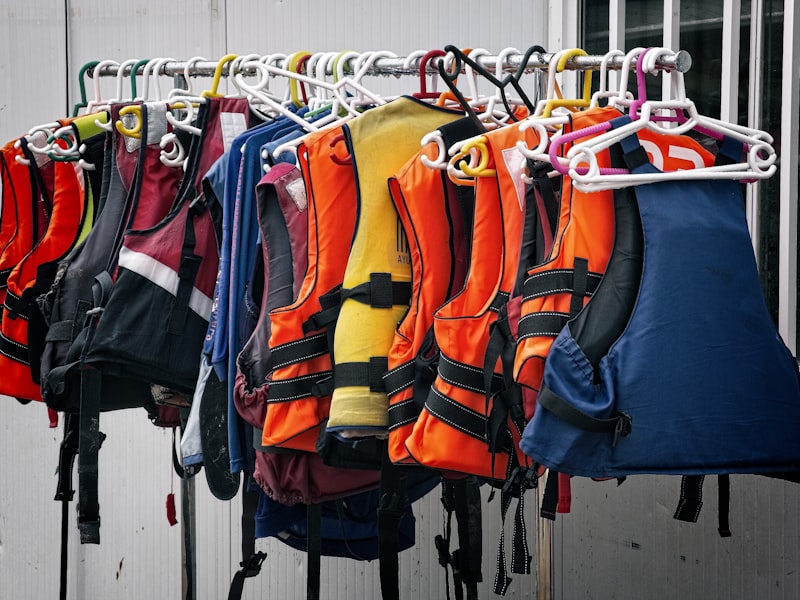
What the Coast Guard Actually Requires
Probably should have led with this section, honestly. Federal law says you need one wearable life jacket for every single person aboard. No exceptions. And if your boat is 16 feet or longer, you also need a throwable device — like one of those ring buoys or cushions you can toss to someone in the water.
Every jacket has to be Coast Guard approved, in serviceable condition, and the right size for whoever’s wearing it. I’ve seen people try to get away with adult jackets on kids. Don’t do that. It doesn’t work, it’s not legal, and it’s dangerous. Make sure you’ve got properly fitting children’s jackets if you’re taking young passengers out.
Breaking Down the Types
Type I jackets are the big, bulky offshore ones. They give you the most buoyancy and can actually flip an unconscious person face-up in the water. Commercial vessels require them, and honestly, if you’re doing serious offshore runs, you should have these too.
Type II near-shore vests are what most people picture when they think “life jacket.” They’re a solid middle ground — decent buoyancy, reasonably comfortable, good for protected waters. That’s what makes this category endearing to us boaters — it hits the sweet spot between safety and practicality.
Type III flotation aids? Those are the comfortable ones. Fishermen love them. Water sports folks love them. They’ve got enough buoyancy for a conscious person in calm water, and you can actually move around in them without feeling like you’re wearing a refrigerator.
Then there’s Type V, the special-use category. This includes inflatable life jackets and work vests. Here’s the catch though — inflatables have to actually be worn on your body to count toward the Coast Guard requirement. You can’t just stash them in a compartment.
Inflatables — My Personal Favorite
I switched to an inflatable jacket a few years back and honestly can’t imagine going back. They’re compact, barely noticeable when you’re wearing them, and they provide excellent buoyancy once activated. Some inflate automatically when they hit water. Others you have to pull a cord manually. I prefer the manual ones, personally — had a buddy’s auto-inflate go off when he got splashed by a wave. Pretty funny, actually. Not cheap though.
One thing — and I can’t stress this enough — check your CO2 cartridges on schedule. Follow whatever the manufacturer says. A dead cartridge means a jacket that won’t inflate when you need it most.
Fire Extinguishers
Who Needs Them (Spoiler: Probably You)
If your boat has enclosed engine compartments, any kind of enclosed living space, or permanently installed fuel tanks, you need Coast Guard approved fire extinguishers on board. The exact number depends on how long your boat is, so look up the specific regs for your vessel. I know, it’s tedious. But fires on boats are no joke.
Types and Where to Put Them
B-I extinguishers hold at least 2 pounds of dry chemical. Good for smaller spaces. B-II units pack at least 10 pounds and are required on bigger boats, or you can use them as a substitute for multiple B-I units.
Here’s a mistake I see all the time: people mount their extinguisher right next to the engine or right in the galley. Think about it. If that’s where the fire starts, you can’t reach the extinguisher. Mount them in accessible spots, but away from the areas most likely to catch fire. Common sense, right? You’d be surprised.
Keeping Them Working
Check your extinguishers once a month. Look at the pressure gauge, make sure the pin is in place, inspect the hose. With dry chemical extinguishers, give them a good shake now and then so the powder doesn’t pack down into a brick. Most units need replacing or professional servicing every 5 to 12 years, depending on the manufacturer.
Visual Distress Signals
When You Need Them
Operating on coastal waters? The Great Lakes? Territorial seas? You need visual distress signals. Period. You’ve got two broad categories here: pyrotechnic (things that burn or explode) and non-pyrotechnic (things that don’t). Either way, you need something to say “hey, I’m over here and I need help.”
Flares and Pyrotechnics
If you go the pyrotechnic route, every single one has to be Coast Guard approved and not expired. I usually carry a combo — three hand-held flares plus three aerial flares. Some folks prefer an orange smoke signal paired with night signals. Either approach works.
Here’s the thing people forget: check your expiration dates every year. I had a set expire on me mid-season once because I just… didn’t look. Felt pretty foolish. And disposing of expired pyrotechnics isn’t as simple as tossing them in the trash. Call your local fire department or coast guard station — they can tell you the proper way to get rid of them safely.
Non-Pyrotechnic Alternatives
Orange distress flags and electric distress lights are the reusable option. They don’t expire, which is nice. The tradeoff? They might not be as visible as a bright red flare arcing across the sky, especially in certain conditions. Still, for day sailors on calmer waters, they’re a solid choice and you won’t be constantly replacing expired flares.
Sound Producing Devices
What the Rules Say
Under 40 feet? You need something that can produce an “efficient sound signal.” That’s the actual wording. Pretty vague, right? Boats 40 feet and over need both a whistle or horn AND a bell. Yes, a bell. Feels old-fashioned, but them’s the rules.
What Actually Works
Air horns, whistles, electronic horns — all legal, all fine. My advice? Carry at least two different options. When you’re in thick fog and can’t see 50 feet ahead, a working horn isn’t optional. It’s the only thing standing between you and a very bad day. I keep a can-style air horn at the helm and a pealess whistle clipped to my life jacket. Redundancy is your friend out there.
Extra Gear You Really Should Have
VHF Radio
Technically not required for recreational boats. Practically? I’d never leave the dock without one. It’s your lifeline for emergencies, weather updates, bridge openings, talking to other boats, you name it. Get one with Digital Selective Calling — DSC-equipped radios can send an automatic distress signal with your GPS coordinates. That feature alone could save your life someday.
First Aid Kit
Put together a kit that matches where you’re going and how long you’ll be out. The basics, obviously, but also throw in seasickness meds (you’ll thank me later), plenty of sunscreen, and any prescription medications your crew needs. A decent marine first aid kit doesn’t cost much and it’s one of those things you really don’t want to be without.
Anchor and Line
Ever had your engine die while drifting toward rocks? I have. Once. That was enough to make me take anchoring seriously forever. Size your anchor properly for your boat and typical conditions. Carry enough rode for the depths you’ll be in — and then carry a little more. It’s cheap insurance against a very expensive problem.
Navigation Lights
Required from sunset to sunrise and anytime visibility drops. Test your lights before you head out, not when you realize they’re dead at dusk five miles from the marina. Carry spare bulbs too. I keep a small bag of spares right next to the helm. Takes up basically no space.
EPIRB and PLB
Emergency Position Indicating Radio Beacons are what you want for offshore work. They transmit your distress signal to search and rescue authorities anywhere in the world via satellite. If you’re heading beyond VHF range, these are essential, full stop. Personal Locator Beacons are the smaller, individual version — clip one to your jacket and you’ve got personal rescue coverage wherever you go.
Safety Briefings — Don’t Skip This
I know, nobody wants to be the captain giving a safety speech while everyone just wants to crack open a cold one and hit the water. Do it anyway. Every single trip. Show your guests where the life jackets live, how to use the VHF radio, and what to do if things go sideways. It takes three minutes and those three minutes could genuinely save someone’s life when stuff hits the fan. I’ve had a guest pull the right fire extinguisher at the right time purely because I pointed it out before we left the slip. Worth it.
Essential Safety Gear
Stearns Adult Life Vest
USCG approved universal life jacket.
First Alert Marine Fire Extinguisher
USCG approved B-1 rated extinguisher.
As an Amazon Associate, we earn from qualifying purchases.



Stay in the loop
Get the latest power and motor yacht central updates delivered to your inbox.