Why 50ft Yachts Lose AC in Hot Water Cruising
Air conditioning failures on 50ft motor yachts causes me genuine frustration—and I’ve watched plenty of owners experience the same sinking feeling when the cabin goes from 72°F to 85°F in the middle of a Caribbean crossing. The problem isn’t usually a single broken part. It’s a chain reaction that starts in seawater.
Your yacht’s AC system isn’t like the one in your house. It runs three interconnected loops simultaneously: raw seawater pulls through a through-hull fitting, flows through a heat exchanger that cools the refrigerant, then cycles back overboard. The refrigerant loop compresses, condenses, and expands to cool cabin air. Underneath it all sits a third loop—oil circulating through the compressor to keep it from seizing.
Anchored in 30 feet of water off Belize, running the AC 18 hours a day, something almost always clogs. That raw-water strainer—the mesh basket sitting right after the through-hull—fills with sand, shell fragments, and sediment way faster than owners expect. I’ve pulled strainers that looked like they hadn’t been cleaned in two seasons. Back-pressure builds. Your seawater cooling loop can’t reject heat anymore. The head pressure in your refrigerant side climbs. The compressor works harder. Within hours, a thermal switch cuts power to protect the motor.
Probably should have opened with this section, honestly. The single most overlooked maintenance item on 50-footers is that raw-water strainer. Not the compressor. Not the refrigerant charge—the strainer. Check it monthly when cruising in warm, shallow water. Every month.
Tropical cruising stresses these loops because suspended sediment and biological growth are constant. Shallow-water anchorages stir up bottom mud. The sun heats the through-hull fittings, accelerating corrosion. Your zinc anodes start disappearing. Scale builds on the heat exchanger tubes. All this happens in just a few weeks if you’re not vigilant.
Compressor Faults That Kill Cooling Fast
The compressor is the muscle of your AC system—when it fails, you don’t get a gradual decline. You get a sudden hard stop.
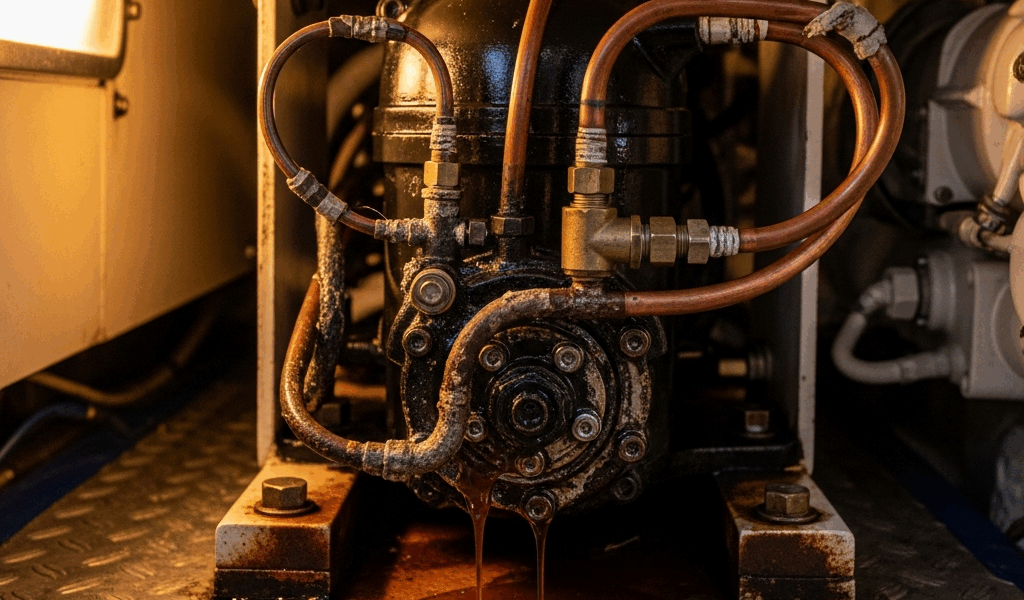
Compressor seizure happens when oil breaks down. In normal operation, synthetic PAO oil circulates through the compressor, lubricating pistons and valves. But under sustained high head pressure—which occurs when your seawater cooling loop is partially blocked—the oil temperature rises past 250°F. The molecules oxidize. Viscosity drops. Lubrication fails. The compressor seizes, the motor draws a surge of current, and your breaker trips. You’re left with warm cabin air and no recovery.
I watched this failure unfold on a Meridian 50 off Eleuthera. The owner had set the thermostat to maintain 70°F and ran the system continuously during a heat wave. After 18 hours straight, the discharge air turned warm. The compressor made a clicking sound every 20 seconds—that’s the thermal overload switch cycling on and off. By evening, it wouldn’t restart.
Low refrigerant is a second compressor killer—your system holds roughly 15 to 22 pounds of R-410A (or R-22 on older boats), depending on cooling load. When refrigerant leaks out, the pressure inside the evaporator coil drops. The thermostat triggers a low-pressure cutout switch, a safety device preventing the compressor from running dry. The compressor shuts down. The cabin stays warm. You keep pushing the thermostat button wondering why nothing happens.
Head-pressure spikes are a third failure mode. If your condenser coil—the seawater-cooled heat exchanger—gets fouled with barnacles or scale, it can’t reject heat efficiently. Pressure climbs to 400+ PSI. The high-pressure switch cuts the compressor. Your AC won’t run until something clears.
Watch for these symptoms: hissing or chirping sounds from the compressor, warm discharge air even when the unit cycles on, a clicking relay that won’t stop, or the compressor refusing to start despite good power at the breaker. These are all warnings that something inside is wrong.
Refrigerant Leaks—How to Spot Them Early
Refrigerant loss is silent and slow until it isn’t.
In normal operation, a well-sealed system loses about 0.5 pounds of refrigerant per year through molecular diffusion. Expected. But a leaking system can lose 2 to 5 pounds annually, or it can lose everything in a catastrophic rupture if a vibrating copper tube wears through against a bracket or frame.
Slow leaks develop when vibration from the yacht’s engines fatigues tubing at connection points. The constant movement of a running 50-footer stresses every fitting, especially on the high-pressure side where copper lines carry refrigerant at 200+ PSI. I’ve found leaks at the condenser outlet, at compressor suction lines, and at indoor unit service ports where installers didn’t double-crimp connections tight enough.
Two diagnostic tools work well. A UV dye test involves injecting a fluorescent dye into the refrigerant line, running the system, then using a UV flashlight to spot escaping dye. An electronic leak detector—a handheld device that sniffs the air and beeps when it senses halogenated compounds—costs $150 to $400 and catches even tiny leaks. Both require caution and shouldn’t be done by an owner working alone.
What I’d absolutely avoid: overfilling a system to compensate for a slow leak. Excess refrigerant causes high head pressure, which cascades into compressor failure. It’s a bandage on a bullet wound. Fix the leak first. Then recharge to spec.
Seawater Cooling Loop Blockages and Corrosion
The seawater side of your AC is a sacrificial system—every component in contact with ocean water is slowly being destroyed.
Zinc anodes are the first line of defense. These soft metal rods corrode preferentially to protect brass through-hull fittings and copper heat exchanger tubes. On a 50-footer, you have three to five anodes in the cooling loop alone. They deplete fastest in tropical, high-salinity water—some owners lose 50% of an anode in six weeks. Once they’re gone, galvanic corrosion attacks the expensive stuff. Your heat exchanger tubes start pitting. Brass fittings develop white fuzzy oxide. The system leaks.
Scale and barnacle buildup in through-hulls and strainers is relentless. Even with monthly strainer cleaning, biological growth clogs mesh within weeks in warm water. Calcium carbonate deposits form on heat exchanger tube walls, reducing water flow and heat transfer efficiency. A 10% reduction in seawater flow means your condenser can’t reject heat properly. Head pressure rises. The AC shuts down on high-pressure cutout.
I’ve opened heat exchangers on boats that haven’t been flushed in a season. The tube bundle looked like a concrete block inside—scale was half an inch thick in spots.
Raw-water strainer clogging is the #1 overlooked cause of AC failure. The strainer is a fine-mesh basket that catches sediment before water reaches the heat exchanger. On a 50-footer, flow rate through the AC system should be 15 to 25 gallons per minute. A dirty strainer cuts flow by 30% or more. The temperature differential across the condenser shrinks. Your compressor can’t cool its discharge gas efficiently. Head pressure climbs. The system cycles off.
Maintenance intervals matter—check the raw-water strainer every month when cruising in tropical or shallow-water zones. Flush the entire cooling loop with fresh water at the end of each season, or more often if you’re in high-growth areas. Inspect zinc anodes visually every two months and replace them if more than half is consumed. Consider installing a sacrificial zinc pencil inside the heat exchanger itself; some units come with one, others don’t.
When to Call a Marine HVAC Tech vs DIY Checks
You can perform three critical diagnostic checks yourself without special tools or certifications.
First, inspect the raw-water strainer. Shut off the AC unit, open the through-hull seacock, unscrew the transparent bowl at the strainer housing, and look inside. If sediment, shell fragments, or slime buildup is visible, clean it immediately. This takes 10 minutes and solves roughly 30% of AC failures I’ve encountered.
Second, check compressor oil color. If you have access to a sight glass on the compressor—most modern marine units do—look at the oil level and hue. Clear, amber oil is healthy. Dark brown or black oil signals oxidation and overheating—your compressor is running too hot. This points to a cooling loop issue or excessive head pressure.
Third, verify thermostat settings. Some owners set the cabin setpoint too low—66°F in 95°F ambient—and the system can’t keep up. Others accidentally set the mode to “ventilation only” and wonder why cool air stops. Walk through the control panel menu slowly. Make sure you’re in AC mode and the setpoint is reasonable.
What you cannot and should not do: handle refrigerant yourself. Federal EPA regulations prohibit venting refrigerant to the atmosphere and require certified technicians to recover, recycle, and recharge systems. Opening a sealed compressor, diagnosing electrical faults, or testing pressures without proper gauges and training risks destroying your system and breaking the law.
A marine HVAC technician call costs $400 to $800 for a diagnostic visit, depending on your location and the yacht’s accessibility. Typical repair timelines run 1 to 3 days for compressor replacement, refrigerant recovery and recharge, or heat exchanger cleaning. If you’re mid-cruise and AC fails, the service cost is worth the relief of restored cabin comfort and the protection of your marine electronics from heat damage.
Call a tech if you see no cold air despite the compressor running, hear abnormal noises—hissing, clicking, grinding—suspect a refrigerant leak, or the cabin temperature won’t drop after 30 minutes of operation. Don’t wait. Heat damage to refrigerant components compounds quickly, and a small leak becomes a catastrophic one within days.


Stay in the loop
Get the latest power and motor yacht central updates delivered to your inbox.