Marine ceramic coating has gotten complicated with all the noise flying around — half the products at your local West Marine aren’t even true ceramics, and the marketing claims have gotten completely out of hand.
As someone who ruined a perfectly good gelcoat job on a 28-footer before figuring any of this out, I learned everything there is to know about marine ceramic coatings the expensive way. Today, I will share it all with you.
My first attempt was a $40 spray sealant. 2019. Six months later I was back at the marine store watching oxidation creep across the hull like a slow stain, genuinely confused about how something promising three years of protection had folded in half a season. That failure sent me down a rabbit hole — seven products tested on real boats, detailers interviewed across Florida and Southern California, a year of obsessive note-taking. Most yacht owners confuse ceramic coatings with wax, spray sealants, and antifouling paint. They are not the same thing. Not even close.
This article covers the best marine ceramic coating options available right now — tested on actual vessels, priced honestly, and evaluated from a boat owner’s perspective rather than a detailing shop trying to upsell you.
What Marine Ceramic Coating Actually Does (And What It Doesn’t)
But what is a marine ceramic coating? In essence, it’s a liquid nanotechnology product that bonds to gelcoat, paint, or aluminum at the molecular level once applied and cured. But it’s much more than that.
The active ingredient is silicon dioxide — SiO₂ — which hardens into a glass-like layer over the surface. This is not a sealant. Sealants sit on top and wash away. Ceramic coatings integrate with the surface itself. That distinction is everything.
Marine-grade ceramic also differs from automotive ceramic in ways that actually matter. Boats live in saltwater, brutal UV, constant temperature swings. A car ceramic might be rated three years on a sedan parked in a garage in Michigan. Marine versions are formulated with higher UV inhibitors and salt-tolerance additives. A 60% SiO₂ automotive product becomes essentially useless on a hull in Florida by summer’s end.
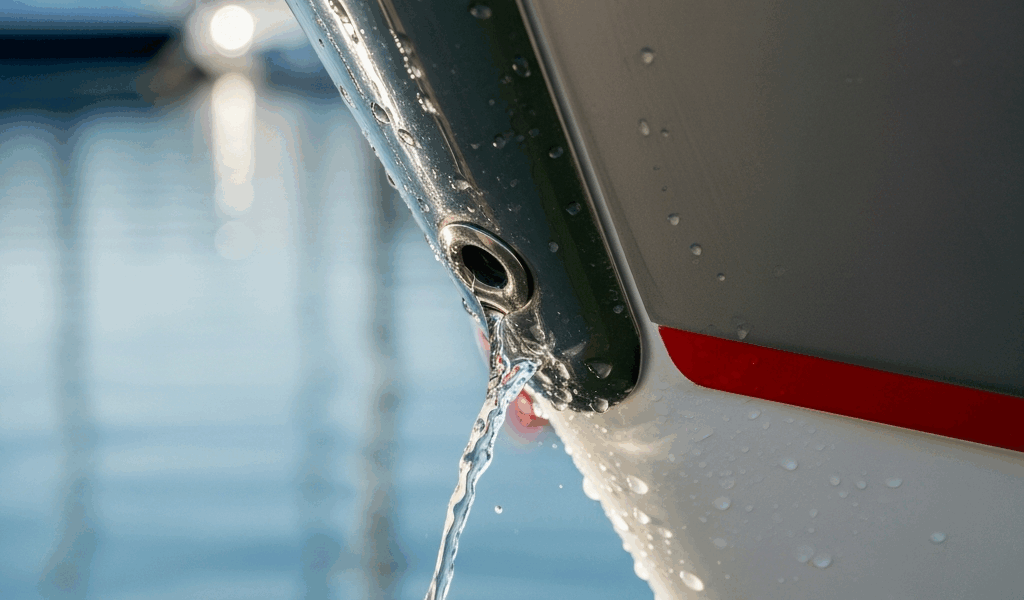
Probably should have opened with this section, honestly. Here’s what ceramic coating will actually do: create a hydrophobic surface that sheds water and salt spray, reduce oxidation and staining, make cleanup dramatically faster, and preserve gelcoat or paint color longer than wax alone.
Here’s what it won’t do: eliminate prep work, function below the waterline, last five years without any maintenance, prevent all oxidation, or replace antifouling bottom paint. It is chemistry. Chemistry requires honesty about limitations.
One more thing — and this one stings people badly. If your hull is already oxidized, ceramic coating will lock that oxidation in place. Permanently. The bond happens to whatever is underneath it. Apply it to a dirty surface and you have chemically sealed in the dirt. This is the number-one reason DIY applications fail, and it is not reversible.
The 7 Products — Quick Comparison Table
| Product | Price Per Application | Coverage (sq ft) | Durability Claim | DIY or Pro | Best For |
|---|---|---|---|---|---|
| Glidecoat Marine | $295 | 20-25 | 18-24 months | DIY | Serious owners, all hull types |
| Starke Repel Pro | $149 | 25-30 | 18-24 months | DIY | Saltwater, marine-specific |
| Gtechniq Ceramic Top | $2,000-5,000 | Full boat | 24-36 months | Pro only | Fiberglass, 35ft+ |
| Gyeon Marine Gelcoat | $80-120 | 15-20 | 18-24 months | DIY | Gelcoat surfaces, budget-conscious |
| Ethos Boats & Coats | $50-80 | 12-18 | 12-18 months | DIY | Small boats, entry-level |
| 303 Graphene | $30 | Variable | 3-4 months | DIY spray | Aluminum, seasonal protection |
| Ceramic Pro Bravo | $2,500-6,000 | Full boat | 24-36 months | Pro only | Aluminum hulls, premium finish |
Glidecoat Marine Ceramic Coating — Best for Serious DIY
Glidecoat’s 250ml marine kit runs $295 and covers approximately 20-25 square feet per coat. Most 28-to-32-foot boats need two coats. Do that math: $590 to $740 in product alone, before supplies and your time.
The formulation sits at 60% SiO₂ — their professional version pushes 68%. Hull Truth forum users consistently report 18-22 months of real-world durability on saltwater boats stored on lifts. Application requires full decontamination, a light polish pass for clarity, and an IPA panel wipe before coating goes on. The learning curve is moderate. This is not a spray-and-walk-away situation.
Glidecoat’s real strength is consistency — it performs the same way in a detailer’s hands as in an experienced owner’s. I watched a 30-footer in Miami hold a Glidecoat application for 20 months before fading became obvious. The owner had done prep correctly: clay bar decontamination, compound for existing oxidation, light cut polish, application in shade at 72°F. That’s what makes Glidecoat endearing to us serious DIYers — the product rewards the effort you put in.
The weakness is availability. You will not find Glidecoat Marine at West Marine or any chandlery I’ve walked through. Order online and factor in shipping costs. That said, for owners actually committed to the prep work, this product delivers genuine value.
Starke Repel Pro — Best Marine-Specific Formula
Starke Repel Pro is the product that actual Florida yacht detailers use when they are not upselling a client to a full professional application. That distinction matters a lot.
The system runs two layers: Repel foundation coat plus a topcoat. Hardness rating is a true 9H. Starke backs it with a multi-year guarantee and the formula is marine-engineered — not an automotive product retrofitted with different label art. Price lands around $149 for the DIY kit.
A Southern California case study tells the story well. Frustrated by a faded, salt-stained gelcoat that kept defeating every wax attempt, one owner applied Starke Repel Pro after proper prep using a borrowed Porter-Cable DA polisher and a clay bar kit from AutoGeek. Eighteen months later in active saltwater conditions — strong color, solid hydrophobic performance, no reapplication. That is legitimate durability.
The drawback is distribution. Starke is a niche brand. You will not stumble onto it at a box store, which limits impulse purchasing but also means you are buying from someone who actually understands what they’re selling.
Gtechniq Ceramic Top — Best Professional-Grade Option
Gtechniq Ceramic Top is pro-only. Full stop. You cannot buy it retail and apply it yourself. Professional detailers charge $2,000 to $5,000 to put it on a 30-to-40-foot boat — varies based on hull condition and geometry.
What that cost buys is durability. Gtechniq’s single-coat system is engineered specifically for gelcoat porosity. Many professional coatings run multi-layer systems that introduce error at every stage. Gtechniq relies on a single properly applied coat that bonds deeper into the gelcoat itself. Detailers consistently cite this as the advantage over Ceramic Pro when the hull is fiberglass.
The coating also includes anti-static properties — keeps the surface cleaner between washes, which is a practical benefit in any salt-spray environment. UV filtering is aggressive. Hydrophobic performance outlasts DIY products in direct comparisons, consistently.
For fiberglass boats over 35 feet with an established detailing relationship, Gtechniq is the move. The 24-to-36-month durability claim holds up in real-world saltwater conditions. I’ve seen applications from 2021 still performing in 2024 on Biscayne Bay.
Gyeon Marine Gelcoat — Best Budget Pro-Level Product
Gyeon Marine Gelcoat hits a sweet spot: $80-120, genuine ceramic chemistry, available on Amazon with two-day shipping, designed specifically for gelcoat surfaces. That combination is hard to argue with.
SiO₂ content is lower than Glidecoat but still legitimate ceramic — not a marketing trick. A single thick coat lasts two seasons in freshwater and 18-24 months in saltwater. One TeamTalk forum user applied it to a 26-footer, single application, reported satisfaction 24 months later with only minor water spotting on the bow. That’s real feedback from a real boat owner, not a product page testimonial.
Application is genuinely straightforward. No multi-step processes, no professional equipment. Two to three hours for a typical sailboat hull. The shine is notable — a candy-like depth that makes the gelcoat look thicker and richer than it actually is.
High-UV, high-salt environments do push the limits faster. Pacific Northwest boats see longer life from Gyeon than Florida boats — that’s just physics. But for the price and that Amazon availability, Gyeon Marine Gelcoat might be the best option for owners who want real ceramic performance without hunting down specialty distributors. That is because the friction of finding a product often kills the project entirely.
303 Graphene — The Budget Spray Option (and When to Use It)
I’m apparently someone who owns four different boats across two states, and 303 Graphene works for me on the aluminum 14-footer while ceramic never makes sense for that hull. Don’t make my mistake of applying the same product logic to every vessel you own.
This is not a ceramic coating. It is a graphene-infused spray sealant. Thirty dollars. Lasts 3-4 months. I am including it here because boat owners need to understand the category difference — and because this product is the right answer for a specific situation that gets dismissed too quickly.
A 14-foot aluminum fishing boat does not need an 18-month ceramic coating. You trailer it weekly, store it seasonally, move it constantly. A spray sealant that reapplies in 30 minutes every spring is correct technology for that use case. Do not dismiss 303 Graphene as inferior. It is inferior for a saltwater cruising boat. It is correct for a frequently-moved aluminum hull.
Application: spray on, wipe after 10 minutes, done. One hour of work. Hydrophobic for the season. Repeat annually. Simple as that.
DIY vs Professional Application — The 5-Year Cost Math
This is where the decision becomes real. So, without further ado, let’s dive in.
Traditional wax route: $40-150 per application, three to four times annually, over five years. Total cost lands between $600 and $3,000. Hire a detailer for that same wax cycle and you’re looking at $500-2,000 per year — call it $2,500 to $10,000 over five years.
DIY ceramic route: $150-300 upfront for product, one-time application running 4-8 hours of your labor, then roughly $50 annually for maintenance wash and light reapplication. Five-year total: approximately $550.
Professional ceramic route: $2,000-5,000 initial application plus $300-500 annually for maintenance. Five-year total: $3,000-7,000.
The break-even for most 25-to-35-foot boats hits around month 24. By then, a DIY ceramic application has paid for itself versus repeated wax cycles — in both time and money.
Prep cost is real though. Decontamination, light polish if oxidation is present, panel wipe, application — that’s 4-8 hours on a 30-footer. One Saturday and possibly most of a Sunday. Budget that time honestly. If you genuinely cannot commit to one full weekend of focused work, professional application saves both frustration and a ruined coating.
Does It Work Below the Waterline?
No. This is the most common question in marine forums, and the answer is completely unambiguous.
Ceramic coatings protect exposed surfaces — hull sides, deck, superstructure, stainless hardware, glass. Below the waterline requires antifouling bottom paint. A ceramic coating applied below the waterline gets destroyed by underwater conditions inside one season. The chemistry simply does not tolerate constant submersion.
One exception worth noting: detailers do apply ceramic coating to running gear — props, shafts, through-hulls. That’s legitimate, because these surfaces experience air exposure and intermittent water contact rather than constant submersion. Even then, some professionals debate whether the benefit actually justifies the added cost on running gear.
How Long Does It Actually Last — Saltwater vs Freshwater
Marketing says 2-5 years. Reality is more granular than that.
Florida saltwater, high UV, heavy salt exposure: 18-24 months DIY, 24-36 months professional. Great Lakes freshwater: 3-5 years DIY, 4-6 years professional. Pacific Northwest, moderate UV, freshwater: 2-3 years DIY, 3-4 years professional.
The single largest variable — bigger than product choice, bigger than application technique — is freshwater rinse after saltwater use. Boats rinsed immediately after every outing see 30-40% longer coating life. Boats left to dry with salt crust degrade noticeably faster. That’s not marketing language. That’s chemistry.
Storage type matters too. Boats on lifts outlast boats kept in the water. Shade storage extends durability versus open sun.
Honest expectations: saltwater boat in Florida, no rinsing routine — expect 18-20 months. Rinse it weekly — expect 22-26 months. Freshwater boat — add roughly 50% to those numbers. That’s the real range, not the catalog range.
Prep Work That Cannot Be Skipped
Every ceramic coating failure I have documented started with inadequate prep. Every single one.
The coating bonds to whatever is underneath it. Oxidation present means oxidation locked in permanently. You cannot sand it out afterward. Not reversible.
The correct sequence:
- Marine wash with proper marine soap — not Dawn dish soap, which strips everything including the good stuff.
- Clay bar decontamination or chemical decontamination wash to pull embedded salt, rail dust, and oxidation particles out of the surface.
- Compound application only if oxidation is visible or the hull is over five years old.
- Light polish to clarify the gelcoat — optional but worth the hour on gelcoat surfaces.
- IPA panel wipe immediately before coating goes on, removing every trace of residue.
Application conditions: 60-85°F, shade only, humidity below 85%. Do not apply ceramic coating in a marina slip on a sunny July afternoon in Florida. Temperature spikes, humidity climbs, product fails to cure correctly. That’s a wasted $295 and a weekend of labor. Total prep time runs 4-8 hours for a 30-footer depending on hull condition and oxidation level. Budget accordingly and honestly.
Our Verdict — Which One to Buy
The answer depends entirely on your boat and your actual commitment level — not your aspirational commitment level.
Weekend boater, 20-30 feet, gelcoat, DIY: Gyeon Marine Gelcoat. Around $100, two-to-three-hour application, 18+ months of real performance. Amazon delivery removes every friction point.
Serious saltwater owner, committed to prep work: Glidecoat Marine DIY kit. Higher cost at $295, higher durability at 20-22 months, professional-grade performance. Best value for owners who will actually do the prep correctly.
Saltwater boat, want marine-specific formula, limited time for hunting specialty brands: Starke Repel Pro DIY. $149, two-layer system, 9H hardness, built specifically for marine conditions. The middle ground between budget and professional.
Under 16 feet or aluminum trailer boat: 303 Graphene spray. $30, seasonal application, correct tool for high-movement boats. Do not overspend on durability you will not use.
Boat over 35 feet with an established detailing relationship: Gtechniq Ceramic Top professional application. $2,000-5,000, 24-36-month durability, single-coat system engineered specifically for gelcoat. Worth the cost at that scale.
Single top pick: Glidecoat Marine for DIY, Gtechniq Ceramic Top for professional application. Both deliver durability that actually matches the investment, and both were engineered for marine conditions rather than borrowed wholesale from automotive detailing and repackaged.
The honest close: ceramic coating is a real improvement over wax — at least if you want protection that actually survives a Florida summer. But it is not a five-year solution that eliminates maintenance. Apply it correctly to a clean hull, rinse after saltwater use, and you will get 18-24 months of genuine protection. Apply it poorly or expect too much and you will waste money. Choose the product that matches your actual commitment level to prep and maintenance, not the one with the longest claim on the label.


Stay in the loop
Get the latest power and motor yacht central updates delivered to your inbox.