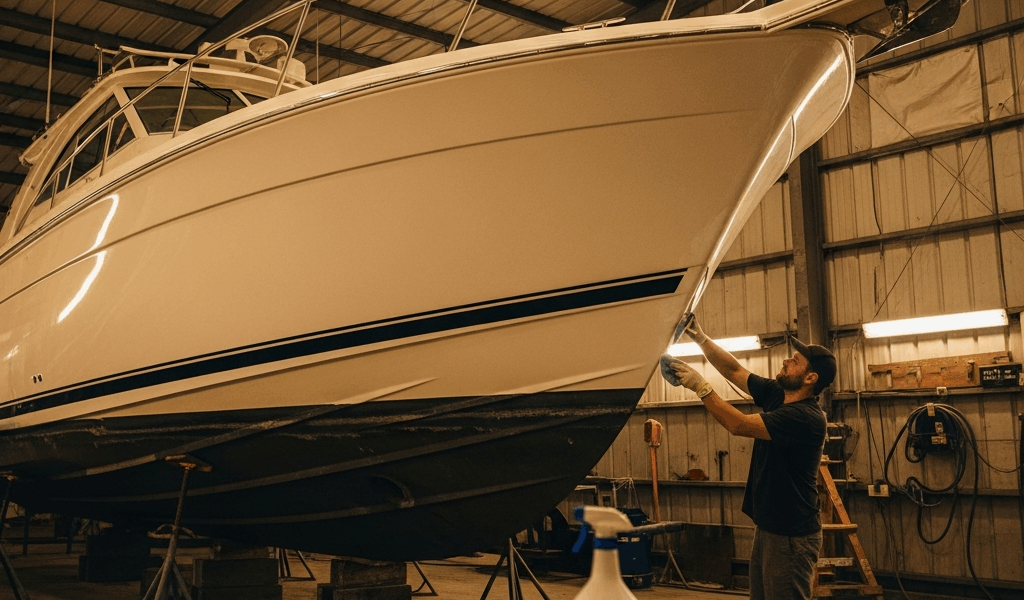
Spring haul-out is three weeks away and the gelcoat on the 32-footer has that chalky, tired look it gets every April. You’ve been waxing this hull for years — same routine, same result. A buddy on a similar boat had his ceramic coated two seasons back and the thing still beads water like it’s fresh off the production line. So here you are, asking whether it’s actually worth it, which product to use, and whether you can do it yourself without making an expensive mistake.
We tested seven products across boats ranging from a 14-foot aluminum fishing skiff to a 42-foot fiberglass express cruiser. Here’s what held up, what the real cost math looks like over five years, and which product fits your specific situation — not a “it depends on your needs” non-answer.
What Marine Ceramic Coating Actually Does (And What It Doesn’t)
Marine ceramic coating is not wax. Say that again at the marina and you’ll get a few nods from people who’ve already made the switch. Carnauba wax sits on top of your gelcoat and gets mechanically worn away — every wash, every salt-spray thrashing, every time the sun bakes it for six hours at anchor. Ceramic coating bonds at the nano level using silicon dioxide (SiO2) particles. Once it cures, you’ve got a layer that rates 9H hardness on some formulations — harder than the gelcoat it’s protecting.
Marine-grade formulations differ from automotive ceramic in three ways that matter: higher UV resistance (UV intensity on the water runs roughly double compared to land), tolerance for salt and chlorine exposure, and enough flexibility to handle the thermal cycling and hull flex that gelcoat sees over a season. Slap an automotive ceramic on a saltwater hull and you’ll typically see edge failures within 8–12 months. The marine versions are built for what actually happens out there.
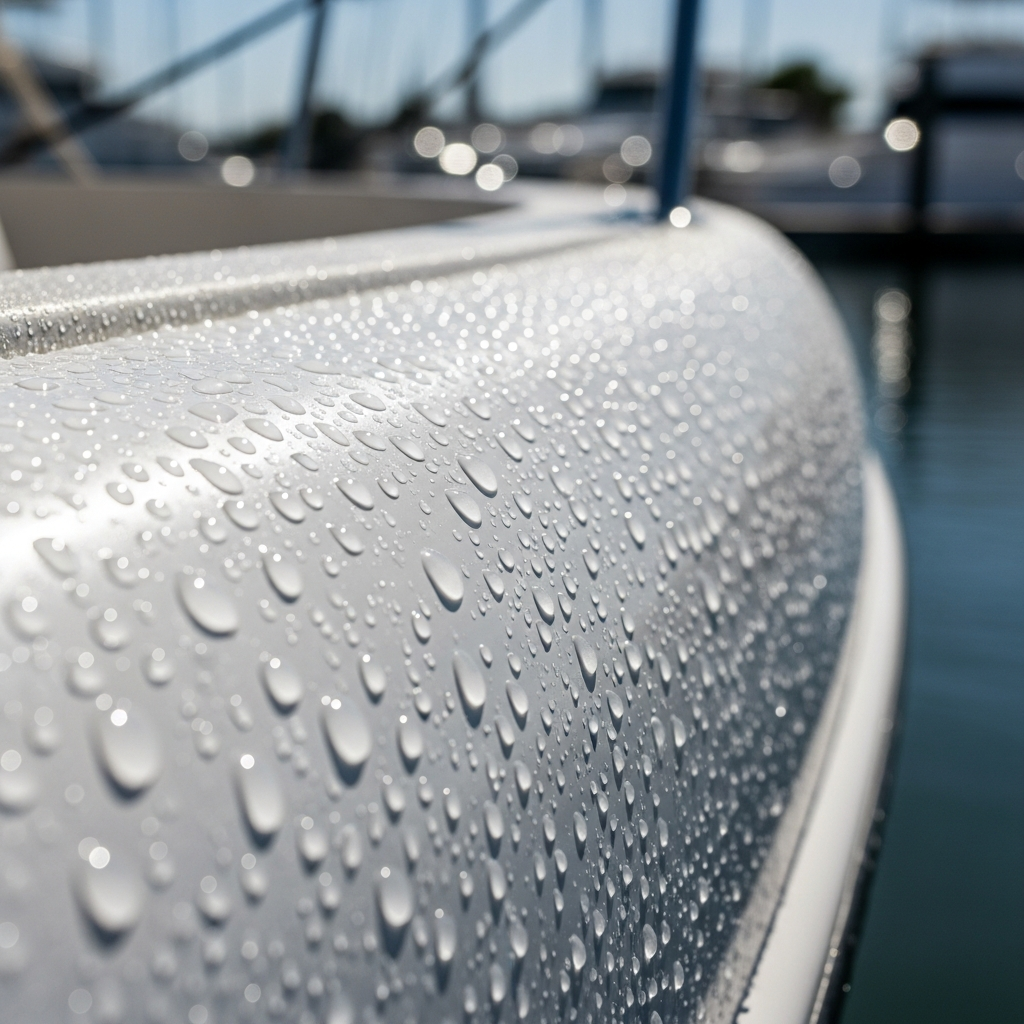
What ceramic genuinely delivers: oxidation prevention that lasts, water beading that stays effective 18–36 months, and a slickness that makes maintenance dramatically faster. Salt, bird droppings, and algae release with a rinse instead of requiring compound and a buffer. After a weekend offshore, a freshwater rinse and you’re done.
What it doesn’t deliver: it will not fix oxidation that’s already there. The coating bonds to whatever’s underneath — oxidation locked under ceramic stays permanently. It has no business below the waterline. It doesn’t eliminate maintenance. And it absolutely won’t perform over contaminated or oxidized gelcoat. If the prep is bad, you’ve sealed the problem in for good.
The 7 Products — Quick Comparison Table
Before getting into each product, here’s the quick reference. Prices are per application for a typical 30–35-foot boat.
| Product | Price (30–35ft) | Coverage | Durability Claim | Hardness | DIY or Pro | Best For |
|---|---|---|---|---|---|---|
| Glidecoat Marine Ceramic | $295 / 250ml | 20–25 sq ft/coat | 18–24 months | 9H (60% SiO2) | DIY | Serious DIY, saltwater liveaboards |
| Starke Repel Pro | ~$149 / kit | Full boat 30–35ft | 18–24 months | 9H (multi-layer) | DIY / Pro | Marine-specific formula, gelcoat |
| Gtechniq Ceramic Top | $2,000–5,000 installed | Professional application | 3–5 years | 9H | Pro only | 35ft+ fiberglass, professional detailing |
| Gyeon Marine Gelcoat | $80–120 / kit | Full boat 30–35ft | 2 seasons | 7H–8H | DIY | Best value real ceramic, gelcoat surfaces |
| Ethos Boats and Coats | ~$50 / kit | Full boat 25–30ft | 12–18 months | 7H | DIY | Budget ceramic entry point |
| 303 Graphene Nano Spray | $30 | Full boat any size | 3–4 months | N/A (spray sealant) | DIY | Small boats, trailer boats, aluminum hulls |
| Ceramic Pro Bravo | $3,000–7,000 installed | Professional multi-layer | 5+ years | 9H+ | Pro only | Superyachts, documented warranty |
A note on compatibility: every SiO2-based product above works on fiberglass gelcoat and painted fiberglass. Aluminum hulls need an extra decontamination pass with a pH-neutral wash before application. Confirm with the product documentation before applying ceramic to painted aluminum.

Glidecoat Marine Ceramic Coating — Best for Serious DIY
Glidecoat is the name that comes up consistently on Hull Truth when serious boat owners compare notes on DIY ceramic. Not occasionally — consistently. The 250ml kit runs $295 and covers 20–25 square feet per coat. For a 30-foot boat, budget two kits if you’re doing hull topsides, deck, and superstructure properly. The Alpha Graphene variant adds graphene to the SiO2 matrix and extends the durability claim to 24 months.
The standard formula is 60% SiO2; the professional version steps to 68%. That gap matters less for a DIY application than it sounds — professional-grade products also require professional-level application speed and prep discipline. At 60%, with proper prep, Hull Truth members consistently report 18–22 months on saltwater boats kept on lifts. That tracks with the marketing claim, which puts Glidecoat in rare company among products that actually deliver what they advertise.
The honest issue: Glidecoat punishes bad prep more than most products. There’s a Hull Truth thread about a guy who applied it over gelcoat that needed compounding first. He got a faint haze locked in permanently. The coating performed exactly as it should — it bonded to the surface it was given. That surface just wasn’t ready.
The verdict: best value for owners who are going to do the prep correctly. The durability is real, the application window is generous for a DIY product, and there’s more community knowledge around this specific product than almost anything else in the category. Check current Glidecoat pricing on Amazon.
Starke Repel Pro — Best Marine-Specific Formula
Starke Yacht Care runs a professional detailing operation in Florida. Repel Pro is what their technicians use on client boats — they started selling it direct after customers kept asking for the product they were using. That origin matters. This isn’t a car-detailing ceramic with a photo of a boat on the label.
Two-layer system: the foundation coat penetrates the gelcoat surface, the topcoat goes over it. True 9H hardness with a multi-year guarantee on correct application. At around $149 for the DIY kit, it’s competitive with Gyeon while coming from a formulation purpose-built for South Florida UV and salt exposure — about as harsh a test environment as boat coatings face in the continental US.
The case that sold a lot of Hull Truth members: a Southern California boat where the port-side gelcoat was going chalk-white within two weeks of compounding under the previous wax schedule. Post-Starke, 18+ months with no return of that oxidation pattern. The initial shine is easy to get with any product. The test is whether it’s still working a year and a half later. Starke passes that test.
The real downside: it’s not on marina store shelves. West Marine doesn’t carry it consistently. You’re ordering online before you’ve held the product. That’s a real consideration for first-time buyers. The tradeoff is a genuinely marine-designed formula rather than something that started in automotive and got a marine SKU added. Starke Repel Pro on Amazon.
Gtechniq Ceramic Top — Best Professional-Grade Option
Ask a professional boat detailer who works with both Gtechniq and Ceramic Pro which they prefer on gelcoat and most will say Gtechniq. The reason is substrate porosity: gelcoat is more porous than automotive clear coat, and Gtechniq’s single-coat chemistry penetrates more effectively in that material than Ceramic Pro’s multi-layer system. The anti-static formulation also means surfaces stay cleaner between washes — less particulate adhesion on a boat sitting in a slip is a meaningful practical benefit.
UV filtration is where this product separates itself from the consumer options. High-UV environments — South Florida, Southern California, the Bahamas — are where the professional application price premium actually pays back. DIY products in those environments run 18–24 months. Gtechniq in professional hands routinely delivers 3–5 years in the same conditions.
Professional application on a 30–40 foot boat runs $2,000–5,000 depending on condition and complexity. Add labor if the boat needs compounding first. The math works for owners who are already spending $1,500–2,000 per year on professional waxing — Gtechniq at $2,500 installed breaks even in roughly 18 months and runs cheaper every year after that.
The verdict: right choice for fiberglass boats over 35 feet with an existing professional detailing relationship. For weekend boaters handling their own maintenance, the DIY options give you 80% of the result at 20% of the cost.
Gyeon Marine Gelcoat — Best Budget Pro-Level Product
The $80–120 price point on Gyeon Marine Gelcoat made us skeptical going in. A lot of products at that level are spray sealants dressed up in ceramic packaging. Gyeon is the real thing — SiO2-based, two-season durability claim, and a clarity on well-prepped gelcoat that’s genuinely impressive on a single coat application.
A TeamTalk forum member posted his application results and came back two years later to report the coating was still performing. That kind of follow-through in forum threads is rare. People come back to complain; they don’t usually come back to confirm satisfaction two years later. It holds up.
Available on Amazon, which makes mid-season reorders straightforward. The application window is forgiving enough for someone doing this for the first time, provided the prep is solid.
Compared to Glidecoat: Gyeon is cheaper and marginally less durable. On a freshwater lake with weekend use, that gap is irrelevant. On a saltwater liveaboard doing offshore passages, Glidecoat’s durability margin justifies the extra $150. For the majority of owners in the middle — seasonal saltwater, lift storage, not crossing oceans — Gyeon is the sensible call. Check Gyeon Marine Gelcoat pricing.
303 Graphene — The Budget Spray Option (and When to Use It)
303 Graphene Nano Spray is not a ceramic coating. The marketing language around graphene products gets slippery, so this needs to be stated plainly: it’s a graphene-infused spray sealant. Goes on in under an hour, provides 3–4 months of protection, beads water well, and requires nothing beyond a clean surface. Thirty dollars a can.
It earns its place in this guide because some boats are genuinely better served by this product than by a full ceramic application. A 14-foot aluminum fishing boat that gets trailered twice a week and accumulates dings and scratches as standard operating procedure does not need a full ceramic prep and application process. The $30 spray applied each season is exactly the right tool. Same logic for jet skis, small center consoles used primarily for freshwater fishing, and anything that gets beaten up enough that protecting the cosmetic surface is a lower priority.
The mistake is applying this reasoning to a 28-foot fiberglass cruiser on a saltwater lift. That boat would benefit from real ceramic protection. Using 303 Graphene on it is a seasonal fix where a one-time application would provide genuine multi-year protection. Match the product to the actual use case. 303 Graphene on Amazon.
DIY vs Professional Application — The 5-Year Cost Math
Here’s where the decision actually lands for most owners. Five-year totals:
Traditional wax, DIY: $40–150 per application, three to four times per year. That’s $120–600 annually, or $600–3,000 over five years. Add your time — four to eight hours per wax job on a 30-foot boat — and you’re looking at 60–160 hours over five years with a buffer in your hand at the marina.
Professional waxing: $500–2,000 per year depending on region and boat size. Five years comes to $2,500–10,000. Each check you write buys you a boat that looks great for about three months before it needs the same treatment again.
DIY ceramic: $150–300 initial application using Gyeon or Glidecoat, $50/year for maintenance wash product, reapplication every 18–24 months adding another $150–300 every other year. Total over five years: $500–800. The application itself is one full day — 8–12 hours for a 30-footer — but you’re doing that once every 18–24 months instead of every 90 days.
Professional ceramic: $2,000–5,000 installation for Gtechniq or Ceramic Pro Bravo, plus $300–500/year for annual maintenance details. Five-year total: $3,500–7,500. If you’re currently spending $1,500+ per year on professional waxing, professional ceramic breaks even around 18 months and runs cheaper from there.
The math for most owners on 25–35 foot boats: DIY ceramic pays back in about two seasons compared to DIY waxing, with real labor savings. The prep day is real — decontamination plus polish plus application is a full day’s work. If you won’t do the prep properly, the $30 graphene spray beats an improperly applied $300 ceramic coating without argument.
Does It Work Below the Waterline?
No. Short answer, and it doesn’t get more complicated than that: ceramic coatings are not antifouling and have no business below the waterline.
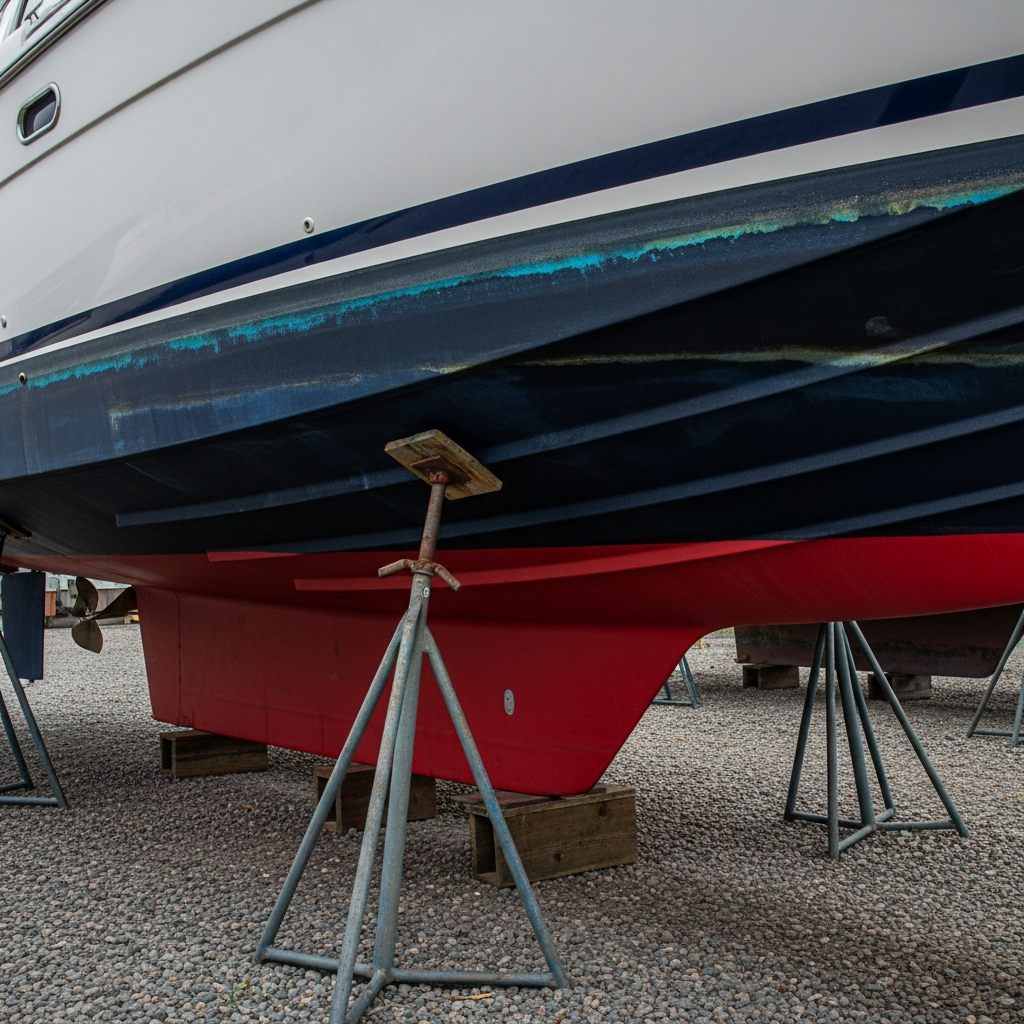
A ceramic coating applied below the waterline would be destroyed in a single season. Antifouling bottom paints work by slowly releasing biocides — ceramic would lock those in and prevent the mechanism from functioning. Biofouling would colonize the ceramic surface the same as any other hard coating without an active antifouling agent.
The valid applications: hull topsides, deck, superstructure, hardtop, stainless hardware, glass. Everything at the waterline and above. Below the waterline stays on bottom paint. That’s the boundary.
The one legitimate exception is running gear. Props, shafts, and trim tabs coated with ceramic show real anti-fouling benefit because the rotation and movement prevents sessile organism attachment in ways that static surfaces can’t replicate. Professional detailers offer this service and it holds up in practice. But that’s running gear specifically — not hull bottom treatment.
How Long Does It Actually Last — Saltwater vs Freshwater
Marketing says 2–5 years. The real-world variance is wide enough to matter:
Florida saltwater, boat in the water full-time: DIY application — Glidecoat, Starke, or Gyeon — typically runs 18–24 months before water-sheeting performance noticeably degrades. Professional Gtechniq application in the same environment runs 24–36 months. South Florida is the worst-case scenario: high UV, salt, heat, and constant water exposure compounding against the coating.
Great Lakes freshwater, seasonal use: DIY ceramic regularly hits 3–5 years. No salt, moderate UV, and seasonal haul-outs give you a natural inspection point. Many of these boats need the annual maintenance wash far more than a full reapplication.
Pacific Northwest, saltwater seasonal use: 2–3 years is typical. Lower UV helps, but the salt, rainfall, and biological growth in PNW waters work against the coating consistently. Rinsing with fresh water after every saltwater use extends coating life meaningfully in any saltwater environment — this is the single most impactful maintenance habit for ceramic-coated boats.
How the boat is stored adds 30–40% variance. Boats kept on lifts out of the water full-time consistently outlast boats moored in slips. Constant water contact accelerates coating wear at the waterline. Trailer boats get both UV stress when trailering and water immersion when launched — plan for shorter reapplication cycles.
Prep Work That Cannot Be Skipped
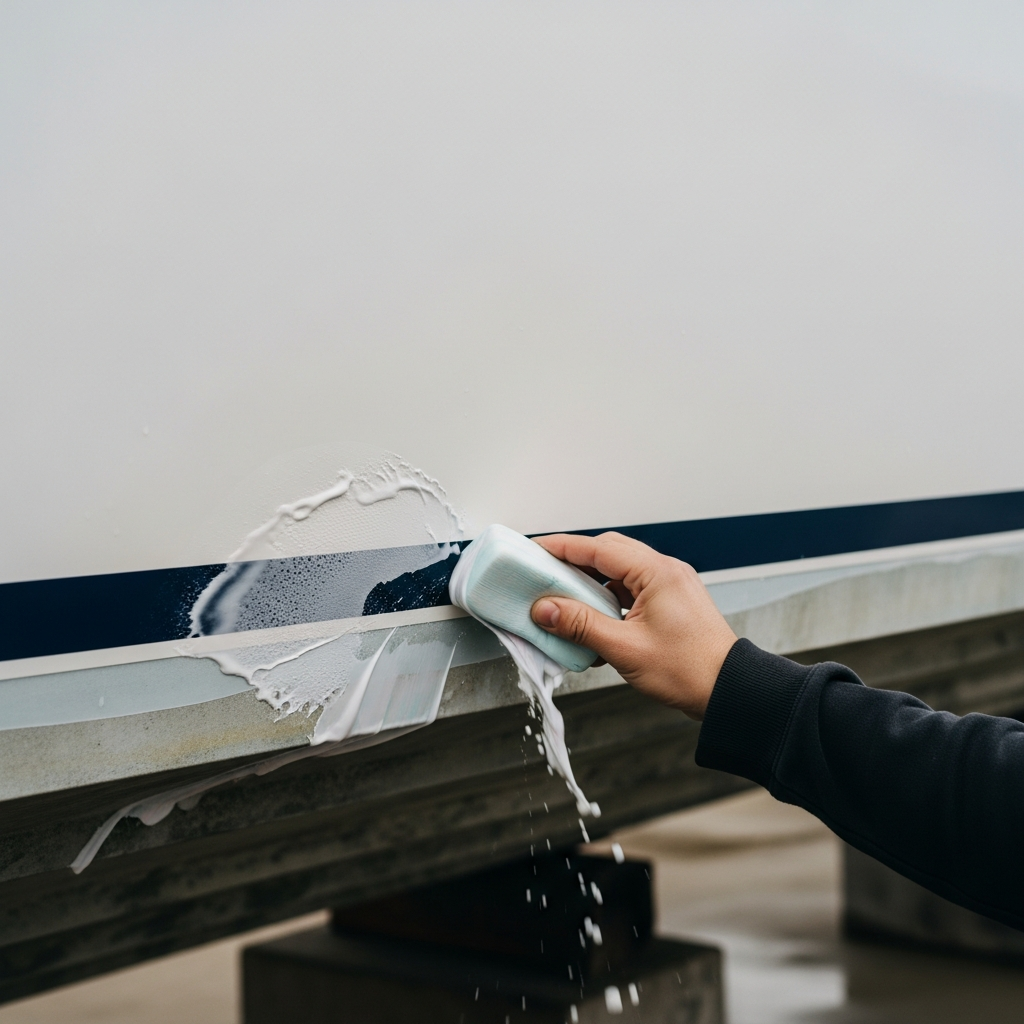
More ceramic coatings fail from bad prep than from bad product. The coating bonds to whatever is under it. Oxidation, contamination, polish residue — all of it gets locked in permanently. There’s no fix for a poorly prepped ceramic application short of cutting through the coating and starting over. That’s not hyperbole; that’s the chemistry.
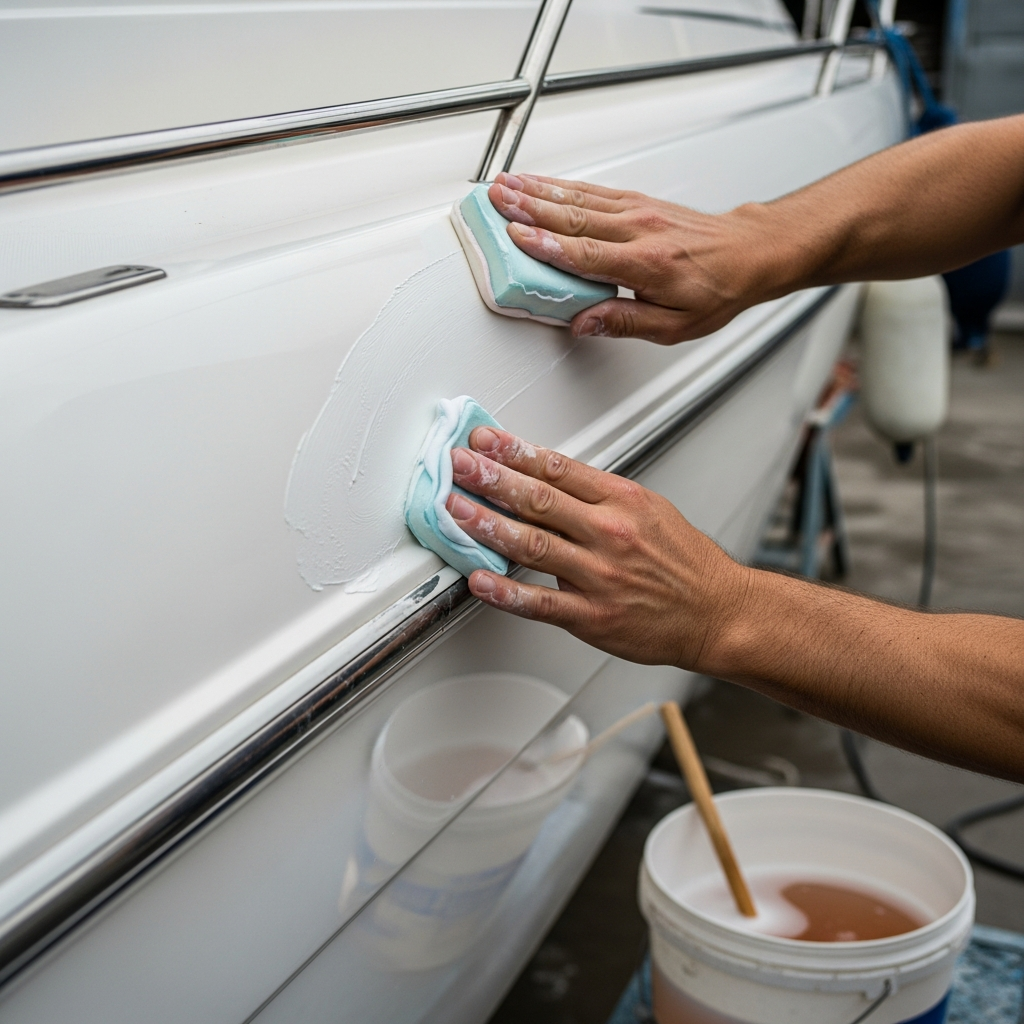
The sequence for a typical fiberglass boat over five years old:
- Step 1 — Marine wash: Full wash with a dedicated marine cleaner — not dish soap. Remove salt, biological residue, and loose contamination. Don’t skip the above-water hull where salt spray accumulates in pockets and seams.
- Step 2 — Decontamination: Clay bar or iron decontamination wash. Marine environments deposit iron oxide from dock hardware, neighboring boats, and salt-air particulate. These don’t come off in a standard wash and they compromise the ceramic bond.
- Step 3 — Compound if oxidation is present: Most boats over five years with meaningful UV exposure need at least a light compound pass. Chalky, dull gelcoat after washing means compound is not optional. A machine polisher with moderate cut compound followed by finishing polish restores the surface that ceramic needs to bond to.
- Step 4 — IPA panel wipe: Isopropyl alcohol wipe of every panel immediately before application. Removes polish oils that block ceramic bonding. Do this panel by panel as you work — don’t IPA the entire boat and then start coating two hours later.
Application conditions matter more than the product instructions typically convey: 60–85°F, shade or overcast, low humidity. Applying ceramic in a marina slip on a sunny July afternoon — exactly when you want to be out there after completing a full prep day — is how you get high spots and streaks. The product flashes too quickly in direct sun and heat. Early morning, a shaded boatyard, or an overcast day is what you’re aiming for.
Realistic time budget: 4–8 hours for a 30-foot boat in good condition. Add 3–4 hours if compounding is required. It’s a single full day, not a weekend project. But it’s one day every 18–24 months instead of a day every 90 days — and that math adds up quickly over a few seasons.
Our Verdict — Which One to Buy
Here’s the decision without hedging:
Weekend boater, 20–30ft, fiberglass gelcoat, doing your own maintenance: Gyeon Marine Gelcoat at $80–120. Genuine SiO2 ceramic, forgiving application window, on Amazon, two-season durability confirmed in real use. You don’t need $295 worth of product to get legitimate ceramic protection.
Serious saltwater use — offshore, liveaboard, or heavy seasonal: Glidecoat Marine Ceramic Kit or Starke Repel Pro. The durability margin in harsh conditions justifies the price. Choose Glidecoat if you want the most community-tested DIY option; choose Starke if you want a formula that came directly from professional marine detailing use.
Small boat, trailer boat, or aluminum hull under 18 feet: 303 Graphene Nano Spray. Seasonal application, zero prep requirements, $30. The economics of a full ceramic application don’t work for a boat that takes regular cosmetic abuse as part of normal use.
Boat over 35 feet with an existing professional detailing relationship: Gtechniq Ceramic Top through your detailer, or Ceramic Pro Bravo if your detailer is an authorized applicator and you want a documented multi-year warranty. Professional application quality on a large fiberglass boat justifies the cost when you’re already spending significant money on annual maintenance.
Top pick for most owners: Gyeon Marine Gelcoat. It works across the widest range of use cases, it’s available through normal purchasing channels, it’s genuine SiO2 ceramic rather than a spray sealant, and the 5-year cost math is straightforwardly positive. Step up to Glidecoat or Starke if your situation demands it. For the typical 25–32-foot fiberglass cruiser with a hands-on owner — which describes most of the people asking this question — Gyeon is the right call. Shop Gyeon Marine Gelcoat on Amazon.
Frequently Asked Questions
Can you apply ceramic coating below the waterline?
No — and you shouldn’t try. Ceramic coating has no antifouling properties and would be destroyed within one season of submersion. Antifouling bottom paint belongs below the waterline; ceramic belongs above it. The one exception: running gear (props, shafts) where ceramic has demonstrated genuine anti-fouling benefit because spinning surfaces resist sessile organism attachment better than static hull areas.
How long does marine ceramic coating last?
DIY application in saltwater environments typically delivers 18–24 months before water-sheeting performance noticeably degrades. Professional application in the same conditions runs 24–36 months. Freshwater seasonal use extends those ranges considerably — Great Lakes boat owners commonly report 3–5 years from a single DIY application. Boats on lifts consistently outlast boats in slips by 30–40%.
Does marine ceramic coating work on aluminum boats?
Yes, with extra prep. Aluminum requires a pH-neutral wash that preserves the aluminum oxide layer — which actually aids ceramic adhesion — plus a decontamination step specific to aluminum. Standard marine gelcoat prep can strip the surface in ways that reduce bonding. Check the product documentation for aluminum-specific instructions before applying.
Can I apply ceramic coating myself?
Yes — Glidecoat, Starke, and Gyeon are all designed for DIY application. The coating itself goes on straightforwardly. The prep is where DIY applications typically fail. Budget 4–8 hours for a 30-foot boat in good condition, add 3–4 hours if compounding is needed. Work in shade, 60–85°F, low humidity. Proper prep is what separates a coating that lasts 24 months from one that fails in eight.
Is marine ceramic coating worth it vs wax?
For most saltwater boats over 20 feet, the 5-year cost math makes it clear: DIY ceramic at $500–800 total versus DIY waxing at $600–3,000 over the same period, with substantially less labor. For small boats, trailer boats, or freshwater use with minimal UV exposure, the case is less clear-cut — the 303 Graphene spray may be the more practical option.




Stay in the loop
Get the latest power and motor yacht central updates delivered to your inbox.