Azimut Grande 32M vs 35M — Which One to Buy
The Core Difference Is Not Just Length
Choosing between the Azimut Grande 32M and 35M has gotten complicated with all the spec-sheet noise flying around. LOA, beam, displacement — numbers that tell you almost nothing about what it’s actually like to own either boat. As someone who’s spent real time aboard both hulls, I learned everything there is to know about what separates these two models. Today, I will share it all with you.
Here’s the assumption most buyers walk in with: the 32M is just a shrunken 35M. Same DNA, smaller box, lower price tag. That assumption will cost you. These two boats do not share the same hull philosophy — not even close. The 35M runs a beam of approximately 7.9 meters. The 32M sits closer to 7.3 meters. Sixty centimeters. Doesn’t sound dramatic on paper. Stand in the main saloon of each boat back to back and suddenly the 35M feels like a different category of yacht entirely.
The deck layout tells the same story. Azimut’s designers used that additional beam on the 35M to extend the flybridge footprint and open up the aft cockpit flow. The 32M makes different trade-offs — it prioritizes the master suite and compresses some social spaces to get there. Neither approach is wrong. They’re optimized for different ownership patterns, and knowing that upfront saves you from a very expensive regret later.
Living Aboard Each Boat Side by Side
Probably should have opened with this section, honestly. Interior livability is where real buyers agonize longest — and where brochure photography is least trustworthy.
The Master Suite
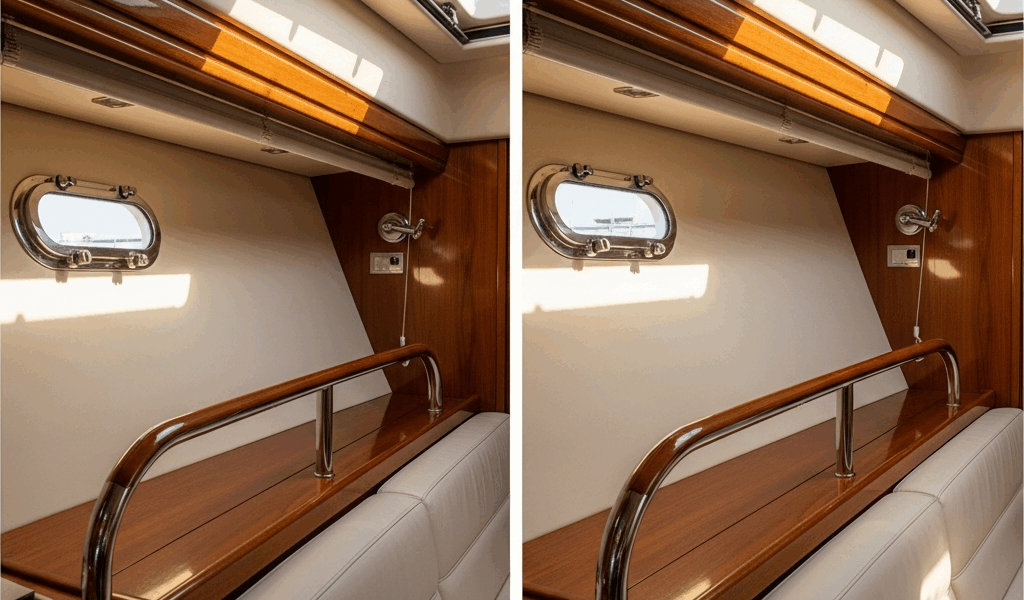
The 32M’s master cabin is genuinely impressive for a sub-33-meter yacht. Full-beam amidships layout, natural light from hull windows port and starboard, and a bathroom that doesn’t make you feel like you’re apologizing for the boat’s size. Headroom runs approximately 2.0 meters throughout — comfortable for most owners. Storage is adequate. Not generous. Adequate. The hanging locker situation is where it starts to pinch if you’re running extended weeks aboard.
The 35M master is a different conversation entirely. More usable floor space, a larger head with a standalone shower enclosure, and — critically — better acoustic separation from the engine room. That last detail matters more than most people expect on a long passage. Don’t make my mistake of dismissing it during the walkthrough.
Saloon Flow and Guest Cabins
The 35M typically runs a four-cabin layout with a five-cabin option depending on build spec. The 32M is three-plus-one at best — and that fourth cabin is tight. Privacy between guest cabins on the 32M is also compromised. The aft guest cabins share a bathroom in most configurations. Fine for a couple’s long weekend. Not ideal for two unrelated families on a two-week Med charter.
But what is the galley situation on each boat? In essence, it’s about where cooking fits into your social life aboard. But it’s much more than that. The 35M positions the galley forward of the saloon, separated from the main social flow — works well for catered charter use. On the 32M it’s more integrated. Better for owner-operated cooking, less ideal when a professional chef is working during a dinner party.
What the 35M wastes — and this surprised me — is the crew area forward on some builds. Disproportionately large for single-captain operation, it steals volume directly from the bow guest cabin. Running the boat with a couple-crew setup rather than a full team means you’re paying for space you’ll never once use.
Fuel Burn, Range, and What It Costs to Run
Real-world fuel numbers shift with sea state, load, and throttle habits. With that context on the table:
- The 32M powered by twin MAN V8-1000 engines burns approximately 250–280 liters per hour at cruise — around 22–24 knots. Drop to displacement speeds near 10 knots and that falls to roughly 80–100 liters per hour.
- The 35M, typically spec’d with twin MAN V8-1200 or equivalent, runs closer to 320–360 liters per hour at the same cruise RPM range. Displacement mode consumption scales up proportionally with the added displacement.
These figures come from owner reports on forums like The Yacht Report and Yachtforums.com — not builder specifications. Builder specs assume ideal conditions and, frankly, flatter both boats.
Usable tank capacity on the 35M is larger — approximately 10,000–11,000 liters versus around 7,500 liters on the 32M. Range at displacement speeds ends up broadly comparable, somewhere in the 1,200–1,500 nautical mile window depending on conditions. Neither boat crosses the Atlantic without a fuel stop. The 32M’s lighter fuel load does make it more comfortable in a following sea when you’re running it light.
Marina fees are where the 35M quietly bleeds money. I’m apparently obsessive about this detail, and the math is jarring once you run it. In Portofino, Capri, or Mykonos at peak season, those extra three meters push you into the next pricing bracket. Over a six-month Med season, that difference compounds hard — I’ve seen owners absorb an additional €15,000–€25,000 annually in marina fees on the 35M compared to 32M owners in identical locations. And that’s before you touch the fuel bill.
Crew and Charter Considerations
Frustrated by spec sheets that ignore operational realities, I spent an afternoon working through this with a captain who had run both models in charter programs out of Palma de Mallorca. The differences become obvious the moment you’re thinking about crew requirements.
The 32M can be operated by a single experienced captain with a deckhand — some owners run it captain-only for coastal Mediterranean cruising. The 35M functionally requires two crew minimum for any extended program: captain plus one. For owner-operated use, the 35M’s systems load — stabilizers, bow thruster configuration, docking management — pushes most buyers toward hiring at least a part-time captain.
Charter licensing adds another layer. Under MCA Large Yacht Code provisions and many European flag states, the threshold triggering additional safety equipment, crew certification requirements, and structural survey obligations sits around 24 meters. Both boats clear that threshold. But the number of paying guests you can carry depends on gross tonnage — not just length. The 35M’s larger volume may push it into a different GT bracket depending on build year and flag state. That changes your charter license category and the compliance costs attached to it.
If you’re placing either boat into a charter management program — through Azimut’s own network or a third-party operator like Fraser or Burgess — confirm the gross tonnage calculation with a surveyor before signing anything. The 35M’s superior guest cabin count makes it attractive to charter brokers. The compliance overhead can erode that revenue advantage faster than most buyers anticipate.
Who Should Buy the 32M and Who Should Buy the 35M
So, without further ado, let’s dive in. Not demographics — actual use cases that map to each boat.
Buy the 32M If
- You’re a couple who hosts weekend guests, occasionally fills three cabins, and values owner-operated simplicity over raw hosting capacity.
- You plan to cruise the Western Med — Balearics, Ligurian coast, Croatia — where marina berth availability at 32 meters is meaningfully better than at 35.
- You’re entering the Grande line for the first time and want to understand the ownership model before committing to the operating costs of the larger boat.
- Your five-year exit strategy is resale into a liquid mid-market. The 32M has historically moved faster in the €3–5M used bracket than the 35M, which sits in a noticeably thinner buyer pool.
Buy the 35M If
- You’re running multi-week family cruises with two or three families aboard simultaneously — privacy between cabins is non-negotiable for that scenario.
- Charter revenue is a meaningful part of your ownership financial model. The four-cabin layout earns more per charter week and brokers book it more readily.
- You run the boat with a professional crew and want the crew quarters and systems specification to actually support that properly.
- You’ve owned a comparable boat before and know exactly what you’re getting into with the operating budget.
My honest read after time on both: more buyers than you’d expect who stretched for the 35M wish they’d taken the 32M. The 35M might be the better boat by several measurable metrics — as yacht ownership requires both capability and livability, that’s because raw specification rarely captures daily experience. The 32M is more manageable, cheaper to berth, and — this genuinely surprised me — more enjoyable day-to-day for couples and small groups. The spaces feel appropriately scaled rather than perpetually underused. That’s what makes the 32M endearing to us owner-operators who actually live aboard rather than charter it out full-time. If you’re financing the purchase and projecting charter income to offset costs, run the real numbers with an actual charter manager before you commit. The 35M’s revenue premium rarely covers the operating cost gap cleanly. Go in with clear eyes.

Stay in the loop
Get the latest power and motor yacht central updates delivered to your inbox.