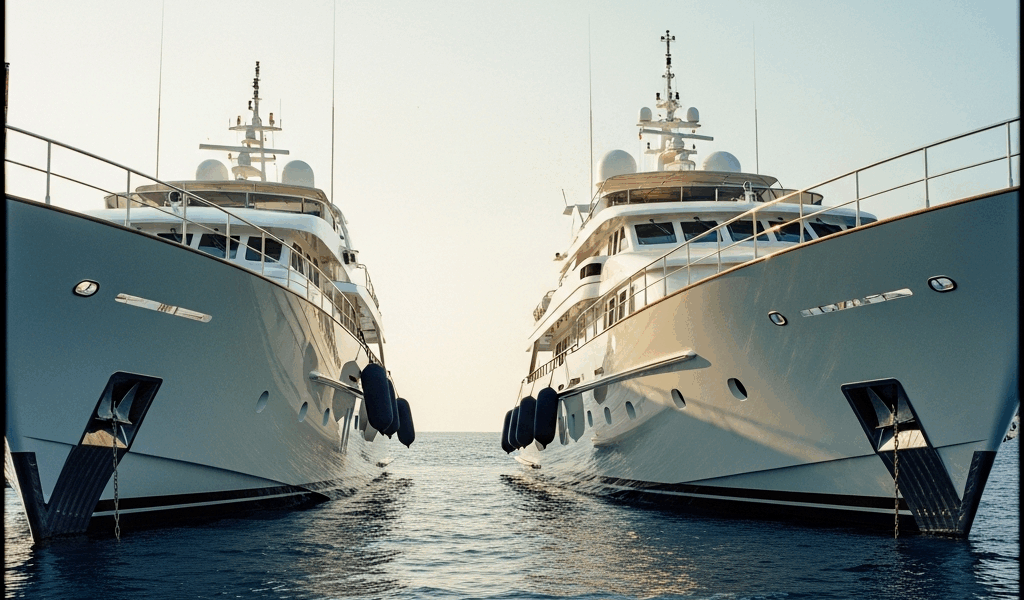
Azimut vs Sunseeker — Which Yacht Is Worth the Money
The azimut vs sunseeker debate has gotten complicated with all the brand loyalty and spec-sheet noise flying around. Ask in any marina bar or yacht broker’s office and you’ll get either a die-hard loyalist who can’t admit they might have overpaid, or some exhausting spreadsheet comparison that tells you nothing about living with one of these boats for five actual years.
What You Are Actually Choosing Between
But what is this comparison really about? In essence, it’s two distinct boating philosophies wrapped in fiberglass and chrome. But it’s much more than that.
First, let’s narrow the field. Azimut and Sunseeker don’t genuinely compete across their full lineups. Under 45 feet, Azimut has a much deeper catalog — Sunseeker thins out considerably. Above 90 feet, you’re in semi-custom territory where the whole conversation shifts. The real cross-shopping happens between roughly 50 and 80 feet. That’s where both builders offer mature, well-developed models. That’s also where buyers are spending somewhere between $500,000 used and $2 million new.
The typical Azimut buyer skews toward someone who prioritizes interior design and entertaining. Italian aesthetic. Lots of glass, contemporary furniture, a saloon that genuinely impresses guests. The Sunseeker buyer tends to want something sportier, more aggressive on the water — often with a stronger connection to British or Northern European boating culture. Neither profile is wrong. They’re just different. That’s what makes each brand endearing to its respective crowd.
What matters — and I can’t stress this enough — is that you don’t buy the brand. You buy the boat. And these boats are genuinely different in ways that only show up after your first full season aboard.
So, without further ado, let’s dive in.
Build Quality and Fit Out
Probably should have opened with this section, honestly. Build quality is where the real disagreement lives — and where the most money gets lost by buyers who don’t look closely enough.
Azimut uses resin-infused composite construction across most of their mid-range lineup, including the popular Azimut 55 and Azimut 72. Infusion reduces voids in the laminate and produces a more consistent hull than older hand-layup methods. Owners report that Azimut hulls hold up well over time — fewer stress crack complaints than you’d expect at this price tier. Interior fit-out quality improved significantly around 2015. Before that? Mixed bag. Earlier models sometimes showed delamination in cabinetry and shoddy finishing on interior hardware that felt embarrassing for the price tag.
Don’t make my mistake. I didn’t look closely enough at a 2012 Azimut 58 during a survey once and found cabinetry issues that cost real money — we’re talking $14,000 in remediation — to address properly. Look carefully at any pre-2015 example. Bring a flashlight and open every locker.
Sunseeker’s reputation is built on coachwork. The Poole, Dorset facility has been building fiberglass yachts since the 1960s, and there’s a genuine craft-tradition feel to their interiors that’s difficult to replicate at scale. The Manhattan 66 and Predator 74 show it clearly — tight woodwork, consistent upholstery, and helm ergonomics that feel like someone actually sat in that seat during the design process. Where Sunseeker has drawn criticism is gelcoat quality on some production runs from the late 2010s. Osmotic blistering was reported more than you’d want on boats of that age — frustrating for a builder with that kind of heritage.
On balance: Azimut wins on material modernity. Sunseeker wins on traditional fit-and-finish craft. Which one matters more depends entirely on whether your boat lives in warm, shallow Mediterranean water or colder Atlantic conditions.
Performance and Handling
Stunned by how many comparison articles skip this entirely — buyers end up genuinely underprepared for how differently these boats actually move.
Azimut has leaned heavily into Volvo IPS drives across their flybridge range, and it shows. The Azimut 60 with twin IPS 1200s is genuinely manageable solo. Joystick docking is responsive. Low-speed maneuverability in a tight marina is confidence-inspiring, even on a breezy afternoon. Cruising efficiency at 22–24 knots is respectable, and the ride in a chop is softer than you’d expect. The deep-V hull sections Azimut runs in their sport models flatten out the motion without turning the boat into a wallower once you drop anchor.
Sunseeker tends to favor traditional shaft-drive configurations in their larger models — IPS options exist, but they’re not the default identity. The Predator line, particularly the Predator 74, has a performance orientation that owners and captains consistently describe as aggressive in the best possible sense. It gets on plane quickly. It carves turns with purpose. At 32–35 knots it feels planted rather than skittish. The trade-off is that shaft-drive boats demand more attention in tight quarters, and the fuel burn at performance speeds is not polite. Figure an extra 15–20 gallons per hour compared to an IPS-equipped Azimut at similar speeds.
Captains who’ve run both tell me Sunseeker rewards an experienced hand. Azimut is more forgiving for the owner-operator who doesn’t have years of professional time behind the wheel. That’s a meaningful distinction if you’re planning to run the boat yourself most of the time.
Dealer Networks and Ownership Costs
This is the section nobody covers properly. It’s also often what actually seals — or quietly breaks — the decision.
Azimut’s North American dealer network runs primarily through MarineMax, which took over the relationship around 2016. MarineMax has locations across Florida, the Northeast, and the West Coast — sounds comprehensive on paper. In practice, owner feedback on service turnaround is genuinely mixed. Parts availability for Italian-sourced components — certain Lewmar hatches, specific upholstery fabrics in the Pelle premium leather line, proprietary electronics housings — can mean 6–10 week lead times if the part isn’t already stateside. In the Mediterranean, this is far less of an issue. The Azimut factory in Avigliana is well-supported regionally, and you’ll rarely wait more than two weeks for anything.
Sunseeker’s US dealer network is thinner, but their European support is strong — particularly in the UK, Monaco, and Croatia. If you’re based in the Med or cross regularly, Sunseeker’s service infrastructure is genuinely excellent. US-based owners in less densely served regions have reported real frustrations getting warranty work done promptly. The Gulf Coast market seems to feel this most acutely.
On resale value: Sunseeker holds slightly better in the European market, where the brand carries real prestige — especially among UK buyers and Eastern European purchasers who treat the Predator badge almost as a cultural signifier. In the US market, Azimut’s resale is comparable and in some cases stronger, largely because MarineMax keeps used inventory visible to active buyers. I’m apparently wired to track this stuff obsessively, and Azimut’s data works for me while Sunseeker’s US numbers never quite stabilize the same way. A 2018 Azimut 60 in good condition was trading at roughly 70–75% of original MSRP in late 2023. A comparable Sunseeker Manhattan 66 landed in a similar range, though with more variance depending on where the boat was listed.
Routine maintenance costs run close between the two brands. Where Azimut can bite you is proprietary components with long lead times. Where Sunseeker can bite you is distance from an authorized service center — and that bite can sting at $180–220 per hour for travel time alone.
Which One Should You Buy
Here’s the actual answer — no hedging.
Buy an Azimut if you’re based in the Mediterranean or Florida, you want a modern interior that impresses guests from the moment they step aboard, you’re running the boat yourself without a full-time captain, and you’re buying a 2016 or newer model. The IPS drive options are genuinely excellent for that use case. The interiors photograph beautifully, which matters more than people admit. And the MarineMax network — imperfect as it honestly is — gives you real touchpoints across the US coastline.
Buy a Sunseeker if performance character matters more to you than interior design trends, if you’re based in the UK or Northern Europe, if you have an experienced captain running the boat regularly, or if you’re buying used in the 50–65 foot range where Sunseeker’s craft quality still shows strongly in the condition of older hulls.
The one thing I’d tell any buyer at this level — and I’d say it firmly: don’t buy the brand. Survey the specific hull. A well-maintained Sunseeker Manhattan 66 from 2017 will outperform a neglected Azimut 60 from 2019 in every way that matters for daily ownership. Hire a qualified marine surveyor who knows both brands specifically — not a generalist who does fishing boats on Tuesdays — and let the condition of that individual boat drive the final call.
Both builders make genuinely good yachts in this range. The question is which one fits your water, your crew situation, and your actual idea of a good day on the boat. Answer that honestly and the choice gets obvious fast.


Stay in the loop
Get the latest power and motor yacht central updates delivered to your inbox.