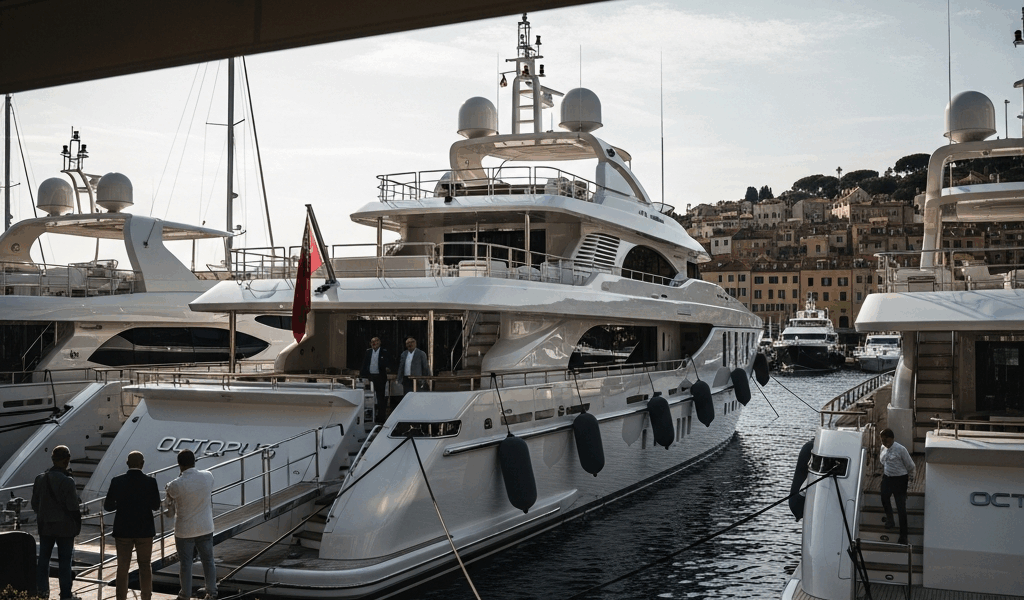
Who Owns the Octopus Yacht Now? Inside Paul Allen’s 414-Foot Legacy
The Octopus yacht has gotten complicated with all the speculation flying around about who actually owns it and what they’re doing with it. The short answer: Roger Samuelsson, a Swedish pharmaceutical billionaire, bought the thing in 2021 for somewhere around $275 million. But stop there and you’ve missed the whole story. I once made the mistake of assuming these vessels were glorified floating mansions. Octopus corrected that fast.
Who Owns the Octopus Yacht in 2026?
Roger Samuelsson. Swedish. Pharmaceutical money. Billionaire. Those four facts are what circulate most, and they’re accurate as far as they go.
Samuelsson finalized the purchase in 2021 — roughly three years after Paul Allen died in October 2018. The reported price tag hovered consistently around $275 million, making it one of the most expensive superyacht transactions ever documented. To put that number in some kind of perspective: it exceeds the GDP of certain small island nations, and it apparently still represented a discount from the original construction cost once you factor in the specialized scientific hardware built directly into the hull.
As of 2026, Octopus remains one of the largest and most technically sophisticated privately owned vessels afloat. Samuelsson has kept a noticeably low profile compared to Allen’s public-facing persona — but the yacht keeps showing up at major ports and remains at least partially available for private charter through select brokers. More on that in a bit.
Why Paul Allen Built Octopus
This is the section most people skip. Don’t make my mistake — I skimmed it the first time and had to go back and read the whole thing twice.
But what is Octopus, really? In essence, it’s a 414-foot superyacht built for ocean exploration. But it’s much more than that. Paul Allen wasn’t purely chasing a status symbol when he commissioned this vessel in the late 1990s. He co-founded Microsoft, yes — and he also funded the Allen Institute for Brain Science, backed SpaceShipOne, and sank money into scientific endeavors with no obvious commercial return whatsoever. The ocean was just another frontier in that same category for him.
Frustrated by the limitations of conventional research vessels, Allen commissioned Octopus through Lürssen — the Bremen-based German shipyard responsible for some of the most technically demanding builds in superyacht history. Delivered in 2003, the vessel stretches 414 feet — about 126 meters — which put it in genuinely rare company at the time. But the length isn’t really the point. The equipment is the point.
Two submarines. Two. A remotely operated vehicle system capable of reaching serious ocean depths. A dedicated decompression chamber. Two helicopters sitting on a helipad large enough to accommodate both simultaneously. A recording studio below deck. A basketball court. A glass-bottomed swimming pool positioned directly over the ocean below the hull.
Allen used the yacht to fund and actively participate in deep-sea exploration — real exploration, not the PR-friendly kind. In 2015, his crew helped locate the wreck of the USS Indianapolis, the WWII heavy cruiser whose story became famous through Jaws. That wasn’t a publicity stunt. His team had been working the search for years using the yacht’s ROV systems — the same remotely operated vehicles that weren’t exactly consumer-grade equipment.
The recording studio, by the way, is not a token gesture. It’s a full professional setup — built to a standard where actual sessions happened aboard. Allen jammed with Bono and Mick Jagger. The studio existed because he genuinely needed it to.
What Happened to Octopus When Paul Allen Died in 2018
Probably should have opened with this section, honestly, because it reframes the entire $275 million sale question entirely.
Allen died October 15, 2018 — complications from non-Hodgkin lymphoma. He was 65, unmarried, no children. His estate, reportedly north of $20 billion, passed to his sister Jody Allen and a team of trustees charged with executing an extraordinarily complex philanthropic plan.
Octopus presented a specific problem: it wasn’t liquid. You can’t sell a 414-foot superyacht on a Tuesday and have the wire cleared by Friday. The vessel burns through an estimated $20–30 million per year just in operating costs — crew salaries, fuel, maintenance, insurance, port fees. The crew numbers around 60 full-time people. Those costs kept accruing whether anyone was using it or not.
The estate wasn’t necessarily hunting for top dollar. They needed someone who could actually absorb the ongoing operational burden — a very different qualification than selling a painting or a stock portfolio. The trustees reportedly listed the vessel shortly after Allen’s death, with asking prices bouncing between $325 million and $350 million at various points. Pricing at this level is negotiated anyway, not fixed. The yacht kept operating during the sales process — some scientific mission work, a few charter appearances — partly to keep the crew employed, partly because leaving something this mechanically complex idle causes its own expensive problems.
The $275 Million Sale — Why It Took Three Years to Find a Buyer
Three years is a long time to sell anything. For a superyacht at this price, though, it’s honestly not unusual. The global buyer pool for vessels above $200 million is measured in dozens — not hundreds.
Run the math a potential buyer actually faces. You write a $275 million check. Then you accept a $20–30 million annual operating burn. You inherit a permanent crew of 60-plus people — specialists, not generalists. You manage insurance across international maritime jurisdictions. You arrange berths at ports capable of handling 414 feet, which cuts your options considerably compared to smaller vessels.
Then there’s the specialized equipment sitting aboard — submarines with their own certified operators and maintenance schedules, ROV systems that need dedicated technicians, a decompression chamber requiring ongoing medical certification. A buyer here isn’t just purchasing a boat. They’re acquiring what amounts to a small naval operation with a recording studio attached.
Several prospective buyers reportedly toured Octopus between 2019 and 2021. None committed until Samuelsson. Whether the others flinched at the complexity, the price, or the ongoing cost structure isn’t documented anywhere public. What is documented: the transaction closed in 2021 at approximately $275 million — below the initial asking price, and still firmly among the top superyacht sales in recorded history.
Roger Samuelsson — Who Is Octopus’s New Owner?
Here’s where the research gets interesting — or rather, where it stops being easy. Samuelsson is notably private. Not reclusive in a suspicious way, just not someone who courts press coverage or maintains any public-facing profile comparable to Allen’s.
What’s established: he built his wealth in Sweden’s pharmaceutical sector. Sweden produced several pharmaceutical billionaires over the past three decades — largely connected to companies like Recipharm, Oriola, and various biotech ventures that scaled during the European pharmaceutical expansion of the 1990s and 2000s. Samuelsson’s specific business history isn’t exhaustively documented in English-language sources, which makes independent verification of precise figures genuinely difficult.
What’s reported: net worth estimated in the several-billion-dollar range. Real estate holdings. Other asset classes beyond pharmaceuticals. Well known in Swedish financial circles. Zero apparent interest in international media attention.
That’s what makes Octopus endearing to enthusiasts who follow the superyacht world — the mystery of why Samuelsson specifically chose this vessel. At $275 million, other large yachts existed on the market in 2020 and 2021. He didn’t need the most operationally complex vessel afloat. The working theory among superyacht press: he wanted exactly what made Octopus hard to sell — the scientific infrastructure, the submarines, the ROV capability. He’s reportedly an ocean enthusiast. Whether he’s continued Allen’s tradition of funding active deep-sea research isn’t publicly confirmed, but the equipment profile makes it plausible.
What Does Octopus Do Now?
Octopus has appeared at major Mediterranean ports — Palma de Mallorca, Monaco, various Greek island stops — during European summer seasons since the 2021 sale. Caribbean appearances during winter months track with typical superyacht seasonal migration. Nothing unusual there.
Charter availability is honestly the question I get asked most. The answer: yes, Octopus has been listed for charter — at figures that reflect what it actually costs to run the thing. Charter rates at this tier typically land between $700,000 and $1.2 million per week, before expenses. That’s not a number you work toward from a travel budget. It’s the domain of heads of state, tech founders post-liquidity event, and entertainment figures with genuinely unusual balance sheets.
The scientific mission equipment — submarines, ROVs — their active operational status under Samuelsson hasn’t been publicly detailed. The hardware remains fitted aboard, as far as external observation from harbor goes. Whether research missions continue is a separate question. Allen documented his missions and published findings. Samuelsson hasn’t established an equivalent public program. Absence of press releases doesn’t mean absence of activity, though — apparently he just doesn’t feel the need to announce it.
Inside Octopus — The Features That Actually Matter
Let me run through the specifications that get undersold in most coverage, because the standard summary misses the point on most of them.
The Submarines
Two of them — which is unusual even at this price tier. Most superyachts with submarine capability carry one, typically a small leisure unit fitting one or two people. Octopus carries a passenger-capable leisure submersible and a more capable research-grade vessel separately. Two full-scale submersibles on a private yacht reflects Allen’s serious intent toward actual ocean exploration. This new capability took off in the superyacht world several years later and eventually evolved into the submarine amenity enthusiasts know and debate today — but Octopus was early, and more serious about it than almost anyone who followed.
The ROV Systems
The remotely operated vehicles aboard Octopus reach depths well beyond what any manned submersible on a private yacht could safely manage. These are the systems that located the USS Indianapolis — not consumer hardware, but the kind of equipment oceanographic research vessels actually deploy. They need dedicated technicians on staff permanently. That’s not a detail the brochure emphasizes.
The Helicopter Capacity
Two helicopters, helipad sized for both simultaneously. This matters more than it sounds — it transforms the logistics profile entirely. You’re no longer dependent on port access for crew and guest transfers, and emergency medical evacuation becomes genuinely practical at remote locations rather than theoretical.
The Recording Studio
Below deck, built to Allen’s specification, equipped to commercial studio standard. Not a hobbyist corner with some decent microphones — an actual professional setup where real sessions happened. Bono was apparently aboard. Mick Jagger too, at various points. The studio existed because Allen needed it to exist, not because it made for a good listing description.
The Crew Infrastructure
Fifty-seven to sixty permanent crew members. That’s a headcount larger than most small businesses — captain, first officer, chief engineer, submarine specialists, ROV technicians, helicopter crew, medical staff, guest services. Managing that many specialists in a confined marine environment is its own discipline entirely. While you won’t need a background in naval operations to charter Octopus, you will need a handful of qualified people who actually understand what they’re managing.
The Glass-Bottomed Pool
This one gets consistently undersold. The swimming pool has a glass bottom positioned so swimmers look directly into the ocean below the hull. On a vessel this size, that’s not a gimmick — it’s an architectural statement about intent. You’re meant to remain aware of the water below you at all times. Allen built that awareness into the DNA of the vessel from the beginning. It’s probably the detail that best explains what kind of person he was.
Octopus was never just a superyacht — and that’s what makes it endearing to anyone who spends time understanding what Allen actually built. It was a statement about what private wealth could accomplish in ocean exploration. Now it’s Roger Samuelsson’s statement to make. Whether he continues the scientific tradition or keeps the vessel closer to private use, he owns one of the most capable privately built platforms in the water. At $275 million plus roughly $25 million annually to keep running, that’s either the most expensive hobby on earth or a legitimate research operation. Knowing what Allen designed it to be — honestly, probably both.

Stay in the loop
Get the latest power and motor yacht central updates delivered to your inbox.